It’s Not Blue. It’s Not Rare The Way You’ve Been Told. And The Phrase ‘Once In A Blue Moon’ Comes From A Magazine Error In 1946.
Let’s start with the part that’s going to ruin some Instagram captions.
The Blue Moon is not blue.
It’s not a special color. It’s not a different kind of Moon. The phrase ‘once in a blue moon,’ which everyone uses to mean ‘extremely rare,’ is based on a definition that was literally made up by mistake in a magazine article 80 years ago.
And yet, every time one happens, the headlines breathlessly announce another rare celestial event. People post photos of full moons with a blue filter, as if that’s what they actually look like. And somehow, this folklore has become accepted as astronomical fact.
Here’s what’s actually going on.
There Are Two Definitions, And Both Are Modern
There are currently two definitions of ‘Blue Moon’ that astronomers and the public use. Neither of them have anything to do with color.
The first is the seasonal Blue Moon: the third full moon in a season that contains four full moons, instead of the usual three. Most seasons (three calendar months long) contain three full moons, since the lunar cycle is about 29.5 days. Occasionally, a season squeezes in four. The third of those four is the ‘Blue Moon.’
Why the third and not the fourth? Because the seasonal definition was used to keep the names of the other full moons (Harvest Moon, Hunter’s Moon, etc.) aligned with their traditional seasonal positions. The extra moon gets dropped into the third slot to preserve the calendar names.
The second definition — and the one most people know — is the monthly Blue Moon: the second full moon in a calendar month. Since lunar cycles are slightly shorter than calendar months, occasionally you get two full moons within the same month. The second one is what most modern sources call a Blue Moon.
Both definitions are completely artificial. They’re tied to calendars humans invented, not anything astronomical about the Moon itself. From the Moon’s perspective, nothing special is happening.
The Magazine Mistake That Created The Modern Blue Moon
Here’s the wild part: the popular monthly definition came from a misunderstanding.
In March 1946, an amateur astronomer named James Hugh Pruett wrote an article for Sky & Telescope magazine. He was trying to explain the older seasonal definition of a Blue Moon. He misunderstood his source material — the Maine Farmers’ Almanac — and described a Blue Moon as the second full moon in a calendar month.
That was wrong. But the simpler, easier-to-explain definition stuck. Decades later, the article was referenced on a 1980 radio show called StarDate. From there, it spread into board games, trivia answers, and eventually mainstream culture.
By the 1990s, the ‘second full moon in a month’ definition was so widespread that astronomers basically gave up correcting it. Sky & Telescope, the very magazine that originated the error, formally acknowledged the mistake in 1999.
Too late. The Blue Moon you know is the result of a magazine fact-check failure.
How Often Does It Actually Happen?
Monthly Blue Moons happen about once every 2.5 to 3 years.
That’s roughly 7-8 times per generation. It’s not a rare event. It’s a recurring calendar quirk.
Seasonal Blue Moons are slightly less common, occurring about every 2-3 years. Still not rare.
Compare this to genuinely rare astronomical events. A total solar eclipse visible from any specific location happens roughly once every 375 years. Transits of Venus happen in pairs separated by over a century. A great comet bright enough to be visible in daytime might appear once or twice in a human lifetime, if you’re lucky.
‘Once in a Blue Moon’ should really mean ‘every couple of years.’ If you say something happens ‘once in a Blue Moon,’ you’re saying it happens fairly regularly. That’s the opposite of what people mean.
When The Moon Actually Looks Blue
Here’s where it gets interesting. The Moon can actually look blue. It’s just not what we mean when we say Blue Moon.
In rare circumstances, atmospheric conditions can give the Moon a genuinely bluish tint. This happens when the air contains particles of a very specific size — slightly larger than the wavelength of red light. These particles scatter red light more than blue, which is the opposite of normal atmospheric scattering. The result: the Moon appears blue.
What causes this? Massive volcanic eruptions and large wildfires. When Krakatoa erupted in 1883, it threw sulfur particles and ash into the atmosphere that made the Moon appear blue for nearly two years across much of the world. The eruption of Mount St. Helens in 1980 produced blue moons in some regions. Major forest fires in Canada in 1950 caused blue moons across North America and Europe.
These actually-blue moons are genuinely rare. They depend on cataclysmic atmospheric events that happen maybe a few times per century. The phrase ‘once in a Blue Moon’ probably originally referred to this — an actually rare, actually visually striking phenomenon — before the calendar definition took over.
Other Color Tricks The Moon Plays
If the Blue Moon disappoints you for not being blue, take comfort in this: the Moon does change colors regularly. You just have to know what to look for.
The Moon appears orange or red when it’s near the horizon. This happens because you’re looking at it through more atmosphere than when it’s overhead. The atmosphere scatters away the shorter blue wavelengths, leaving the longer red wavelengths to reach your eyes. Same reason sunsets are red.
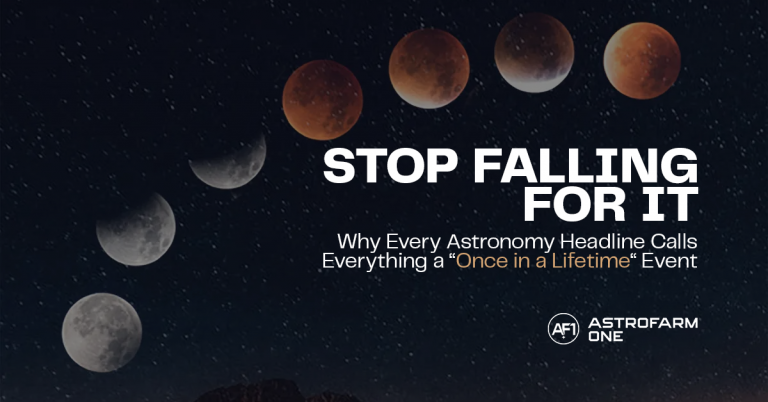
During a total lunar eclipse, the Moon turns deep red — the famous ‘Blood Moon.’ Earth’s atmosphere bends red sunlight onto the Moon’s surface during the eclipse, painting it in essentially every sunset and sunrise happening on Earth simultaneously.
A ‘Strawberry Moon’ (June full moon) isn’t actually pink. A ‘Wolf Moon’ (January full moon) isn’t actually white-blue. These are traditional names for full moons throughout the year, not descriptions of color. The Harvest Moon, Hunter’s Moon, Worm Moon, Pink Moon — all calendar terms, not color terms.
The Moon is, almost always, a shade of white-gray. Sometimes a little yellow, sometimes a little orange, very rarely actually blue. The marketing departments have done a remarkable job convincing us otherwise.
Why The Hype Persists
Every Blue Moon, the headlines fire up: ‘RARE Blue Moon Tonight!’ ‘Don’t Miss This Special Event!’ ‘You Won’t See This Again For Years!’
All technically true. But also misleading.
The Blue Moon looks identical to any other full moon. There’s no special viewing experience. There’s nothing to see that you couldn’t see at last month’s full moon, or next month’s, or any other. The only difference is the name on the calendar.
But media outlets have figured out that ‘Blue Moon’ is good for engagement. The phrase carries cultural weight. People recognize it. They click. They share. Astronomy gets attention.
Which, honestly, isn’t all bad. If hyping up a Blue Moon gets people to actually look up at the sky, mission accomplished. Just don’t expect the Moon to deliver something it can’t.
How To Watch A Blue Moon (Honestly)
If you want to enjoy a Blue Moon properly, here’s what actually matters:
Catch it near the horizon, just after moonrise. That’s when you get the dramatic orange-red color from atmospheric scattering, and when the Moon looks largest due to the Moon illusion (an optical effect that makes the Moon appear bigger near objects on the horizon).
Bring binoculars if you have them. The Moon is one of the most rewarding targets for basic optics. You can clearly see craters, mountain ranges, and the dark lunar maria — the smooth, dark patches of ancient lava plains. Full moon is actually not the best time for telescope observation (no shadows = no contrast), but binoculars work great.
Look up the calendar context. Knowing whether it’s a seasonal or monthly Blue Moon adds nothing visual, but does give you something interesting to share. Plus, you get to be the person who knows the difference.
Skip the photo unless you have proper gear. Smartphone cameras can’t capture the Moon well — it ends up as a tiny white blob in a black field. Either use a real camera with a long lens, or just enjoy the view with your eyes.
The Real Reason To Look Up
Here’s the thing about the Blue Moon hype: even though the rarity is exaggerated and the name is wrong, the Moon itself is still extraordinary.
Every time you look at a full moon, you’re seeing a 4.5 billion-year-old object that formed from debris when a Mars-sized planet slammed into early Earth. It’s the largest moon relative to its planet in the solar system. Without it, Earth’s axial tilt would be unstable, our climate would be chaotic, and life as we know it might never have evolved.
The Moon stabilizes our days, drives our tides, and has watched over every human who ever lived. It’s a quarter-million miles away, slowly drifting further from Earth at about 3.8 centimeters per year. In a billion years, it will be too far away to fully cover the Sun during eclipses. Total solar eclipses will end.
That’s the real story. You don’t need a special calendar designation to make it worth looking at. The Moon is incredible every single night it’s up there. The Blue Moon hype isn’t wrong about wanting people to notice it. It’s just wrong about needing a reason.
So go look at it. Tonight. Tomorrow. Whenever. It’s been waiting for you the whole time.
Sources
Sky & Telescope – Blue Moon History and Definitions – https://skyandtelescope.org
NASA Science – Moon Facts – https://moon.nasa.gov
Pruett, J. H. (1946) – Once in a Blue Moon – Sky & Telescope, March 1946
Olson, D. W. et al. (1999) – What’s a Blue Moon? – Sky & Telescope
Maine Farmers’ Almanac – Historical Blue Moon References