

23. December @ 11:00 pm – 25. December @ 3:30 am CET
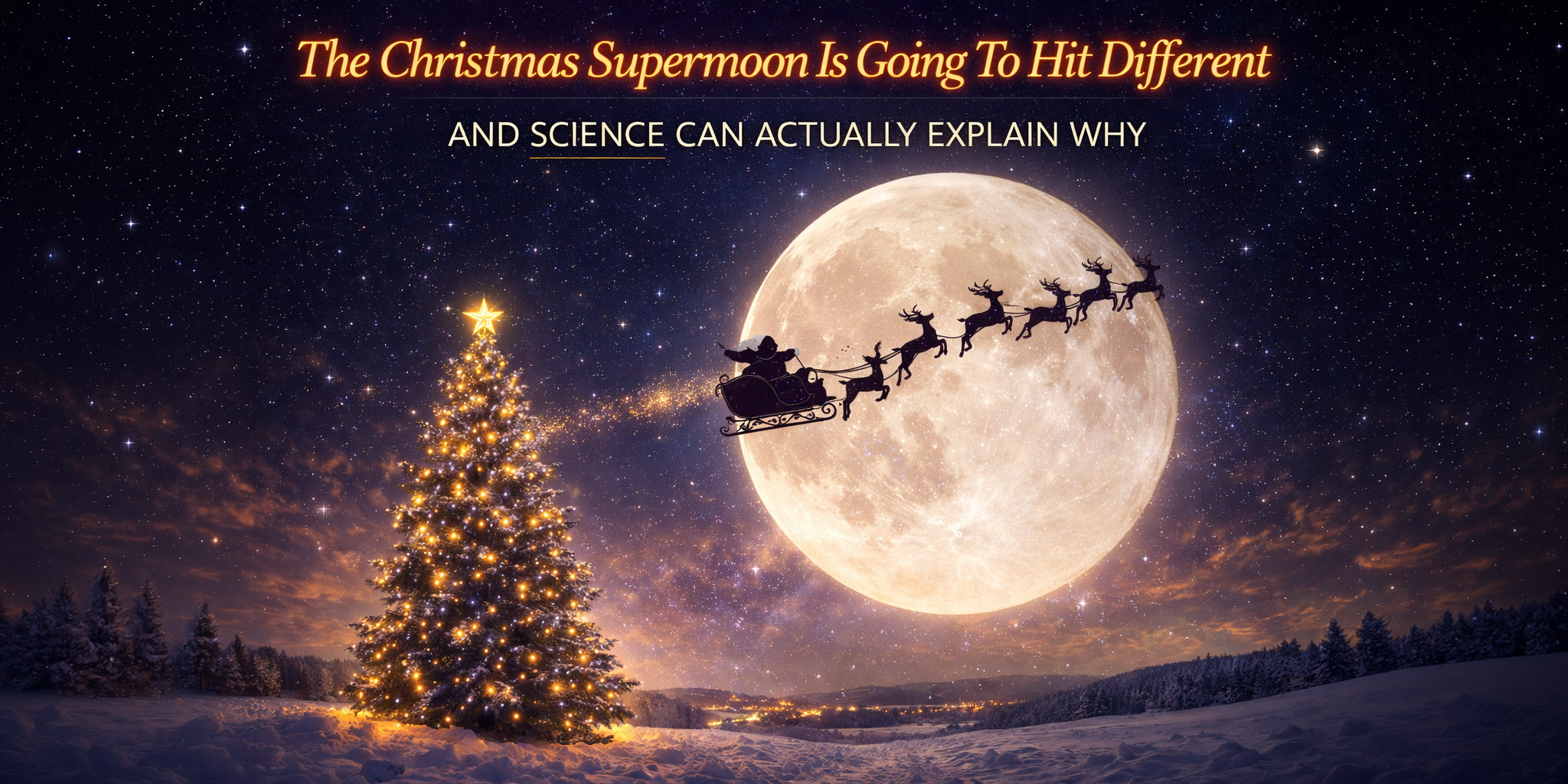
The Christmas Supermoon Is Going To Hit Different — And Science Can Actually Explain Why

December 23-24, 2026: The closest full Moon since 2018, arriving exactly when the whole world slows down.

There are full Moons you notice.

And there are full Moons you remember.

The one on December 23-24, 2026 is likely to be both.

Not because it's dramatically different. Not because something rare or unexpected is happening.

But because timing changes everything.

A supermoon — at its closest point to Earth — appearing just as people across the world slow down, gather, pause.

And suddenly, something ordinary feels different.

The Physics: This Is The Closest Full Moon Since 2018

Let's start with the numbers:

This full Moon occurs near perigee — the point where the Moon is closest to Earth in its elliptical orbit. At this distance, the Moon appears about 7% larger than average, and up to 14% larger than the smallest full Moon of the year.

That's measurable. But subtle.

On its own, you might not notice it.

But perception is never just about numbers.

Context Is Everything

Late December is different.

The nights are long. The air is often clearer. People are outside for different reasons. Or they're inside, but looking out.

And the Moon becomes part of that. A fixed point in a moment that otherwise feels temporary.

That combination changes how it's experienced.

Because this isn't just a supermoon. It's a shared moment.

Across cities, countries, time zones. The same Moon. Seen by millions of people at roughly the same time.

And that creates something subtle, but real. A sense of connection. Not in a literal sense. But in perception.

Because even though everyone is looking from a different place, they're looking at the same object.

And that's rare.

Not Everything Meaningful Has To Be Rare

Astronomically, nothing unusual is happening beyond the geometry. No special alignment. No unique phenomenon. Just orbit. Distance. Light.

But sometimes, that's enough.

Because what makes an observation meaningful isn't always the rarity of the event. It's the moment it exists in.

And this one exists at a time when people are already paying attention. Already reflecting. Already slowing down.

So when the Moon rises — large, bright, steady — it feels like more than just another full Moon.

Even if, physically, it isn't.

And maybe that's the point.

Because not everything meaningful has to be rare. Sometimes, it just has to be seen at the right time.

December 23-24, 2026. The closest full Moon since 2018. Arriving exactly when you might actually look up.

Sources

NASA Moon — https://science.nasa.gov/moon

European Space Agency — https://www.esa.int/Science_Exploration

Peer-reviewed: Chapront et al. (2002), 'Lunar orbital variations and distance'