

6. May @ 12:30 am – 3:30 am CEST
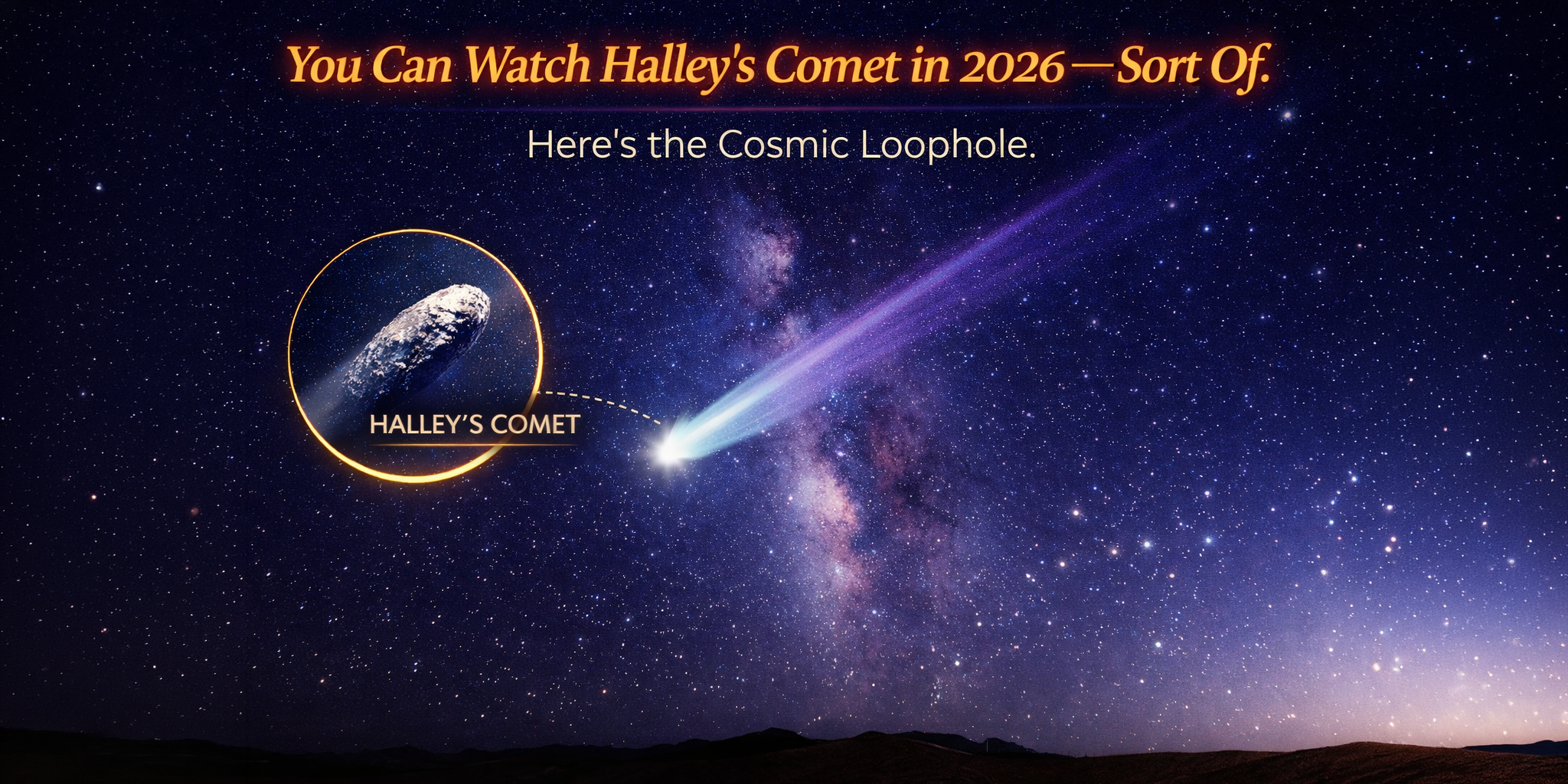
You Can Watch Halley's Comet in 2026 — Sort Of. Here's the Cosmic Loophole.

The Eta Aquariid Meteor Shower: Ancient Comet Debris at 66 km/s. No Telescope Required.

Halley's Comet won't return until 2061. But its ghost shows up every single May.

Let that sink in: You can watch pieces of the most famous comet in history burn up in Earth's atmosphere this year. This May. Before breakfast.

Welcome to the Eta Aquariid meteor shower — one of the fastest, most underrated celestial events of the year.

Wait, How Is This Connected to Halley's Comet?

Comets are cosmic litterbugs. As Halley's Comet travels along its 76-year orbit around the Sun, it sheds particles — dust, ice, tiny rock fragments — that scatter along its path.

That debris doesn't go anywhere. It just hangs out in space, forming a stream that stays in place long after the comet has moved on.

Every May, Earth's orbit intersects that stream. And when those comet fragments hit our atmosphere at speeds approaching 66 kilometers per second (one of the fastest meteor entry speeds possible), they create the Eta Aquariids.

You're not just watching meteors. You're watching comet history — particles released decades or even centuries ago, finally reaching their fiery end.

What Makes These Meteors So Intense?

Speed. Pure, ridiculous speed.

At 66 km/s, the Eta Aquariids are among the fastest meteors you can observe from Earth. When particles hit the atmosphere that fast, the air in front of them compresses so violently that it superheats and ionizes. That's what creates the light.

And sometimes, that interaction leaves behind persistent trains — glowing trails that linger in the sky for several seconds, twisting and fading as they interact with high-altitude winds.

It's kinetic energy turning into heat and light right before your eyes. Physics made beautiful.

How to Catch the Show

Peak viewing: Early May 2026, in the hours just before dawn

The radiant point is in the constellation Aquarius, which rises in the pre-dawn hours. That's why this shower favors early risers and locations closer to the equator (where Aquarius climbs higher in the sky).

In good conditions, expect 20-30 meteors per hour. In 2026, the Moon won't significantly interfere, meaning even fainter meteors will be visible.

Find dark skies. Face east. Show up around 3-4 AM. And bring coffee.

The Bigger Picture

Here's what gets me: You're watching something that happened ages ago finally reach its conclusion.

A comet passed through this region of space. It left debris behind. Earth crossed that debris field. A particle that broke off from Halley decades or centuries ago entered our atmosphere at screaming speed and turned into light.

The meteor lasts a fraction of a second. But the process that created it has been unfolding for thousands of years.

And for a brief window before sunrise, you get to see it happen.

Sources

NASA Meteor Showers – https://science.nasa.gov/meteors

European Space Agency – https://www.esa.int/Science_Exploration

International Meteor Organization – https://www.imo.net