

9. June @ 11:00 pm – 10. June @ 3:30 am UTC+0
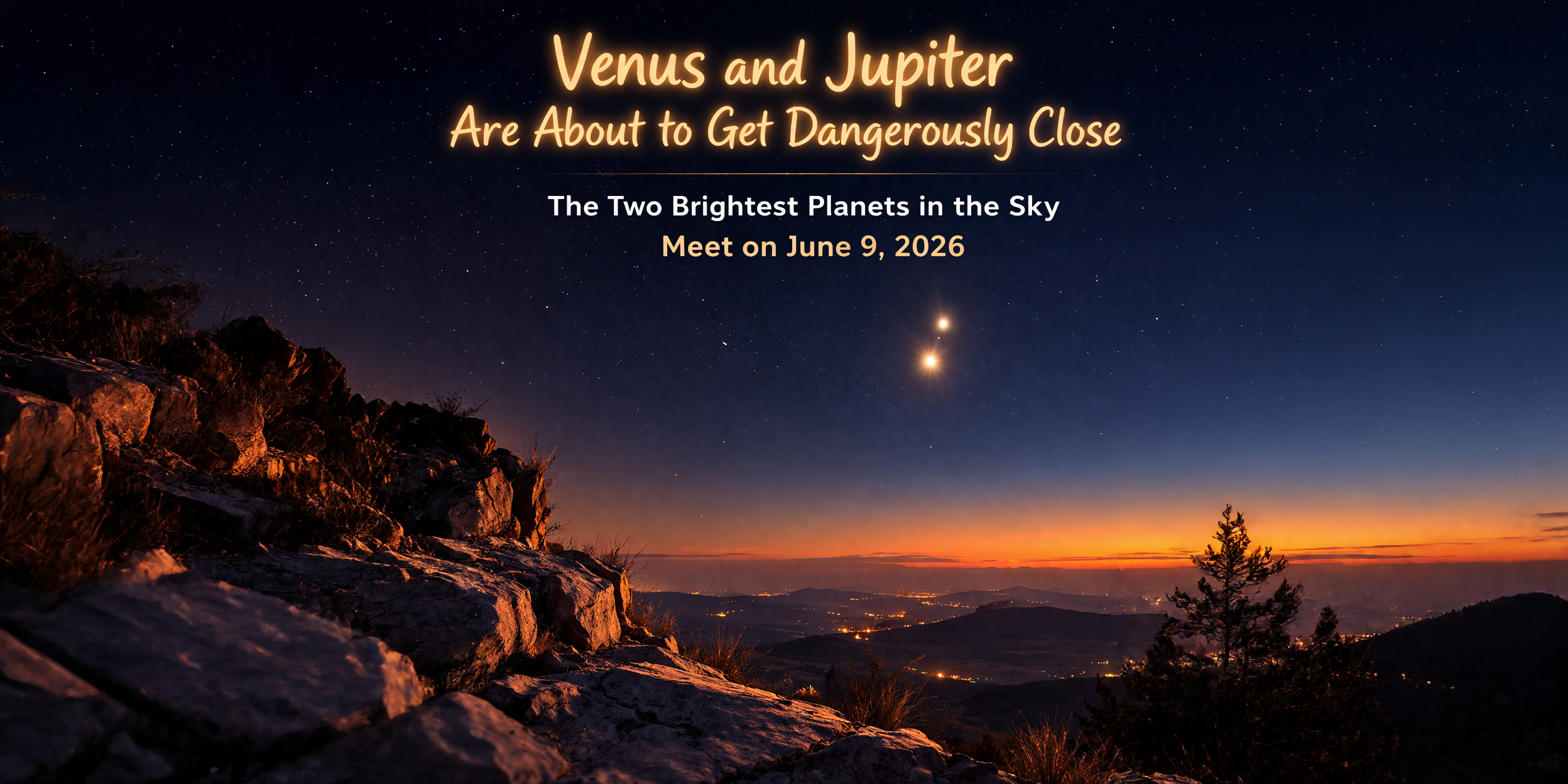
Venus and Jupiter Are About to Get Dangerously Close — And You Won't Need a Telescope

The Two Brightest Planets in the Sky Meet on June 9, 2026. This Is How to See It.

Sometimes the sky just... simplifies itself.

Instead of thousands of scattered stars and hard-to-find constellations, everything collapses into two blazing points of light. Brighter than anything else up there. Impossible to miss. Almost confrontational in their brilliance.

On the evening of June 9, 2026, Venus and Jupiter — the two brightest planets visible from Earth — will appear just 1.5 degrees apart in the western sky.

That's close enough to fit within a single field of binocular view. Close enough to look like they're about to touch.

Close enough to make you stop and stare.

What's Actually Happening Here?

Spoiler: They're not actually close. Not even remotely.

Venus orbits inside Earth's path, never straying far from the Sun in our sky. Jupiter sits way out beyond the asteroid belt, taking nearly 12 years to complete a single orbit.

Their motions are completely independent. Their distances from Earth are vastly different. But occasionally, their lines of sight converge from our perspective — and they appear to meet.

This is a conjunction. Not a collision. Not a physical encounter. Just a perfect alignment of geometry and timing.

And it's stunning.

Why These Two Planets Look So Ridiculous

Venus is the brightest object in the night sky after the Moon. Its thick cloud cover reflects about 70% of the sunlight that hits it — far more than most planets. When it's up, you literally cannot miss it.

Jupiter isn't quite as reflective, but it's massive — and close enough to still outshine every star in the sky. Through even basic binoculars, you can spot its cloud bands. Through a small telescope, you can see its four largest moons.

Put them side by side, and the effect is almost theatrical. Two completely different worlds — one shrouded in acid clouds, one wrapped in storms bigger than Earth — appearing as a luminous pair in the fading twilight.

How to Watch

Date: Evening of June 9, 2026

Look west after sunset. Venus will shine first, even before the sky is fully dark. Jupiter follows shortly after.

You don't need any equipment. Just find a clear view of the western horizon and wait for twilight.

If you have binoculars, use them. The two planets will fit in a single view, and if the atmosphere is steady, you might catch a glimpse of Jupiter's moons scattered around it like tiny diamonds.

Why This Matters

Conjunctions aren't rare. But conjunctions between the two brightest planets in the sky — close enough to fit in your fist held at arm's length — don't happen every day.

And what makes this one special isn't the science. It's the simplicity.

You step outside. You look up. Two blazing lights dominate the western sky, appearing closer together than you'd think possible. No telescope. No planning. No apps.

Just you and the solar system, doing its thing.

Within days, the illusion will fade. Venus will shift position, Jupiter will drift along its slow arc, and the pair will separate.

But for one evening, the sky simplifies itself. And if you're there to see it, that's a moment worth having.

Sources

NASA Solar System Exploration – https://solarsystem.nasa.gov

European Southern Observatory – https://www.eso.org/public/science/