

5. July @ 12:00 am – 3:30 pm CEST
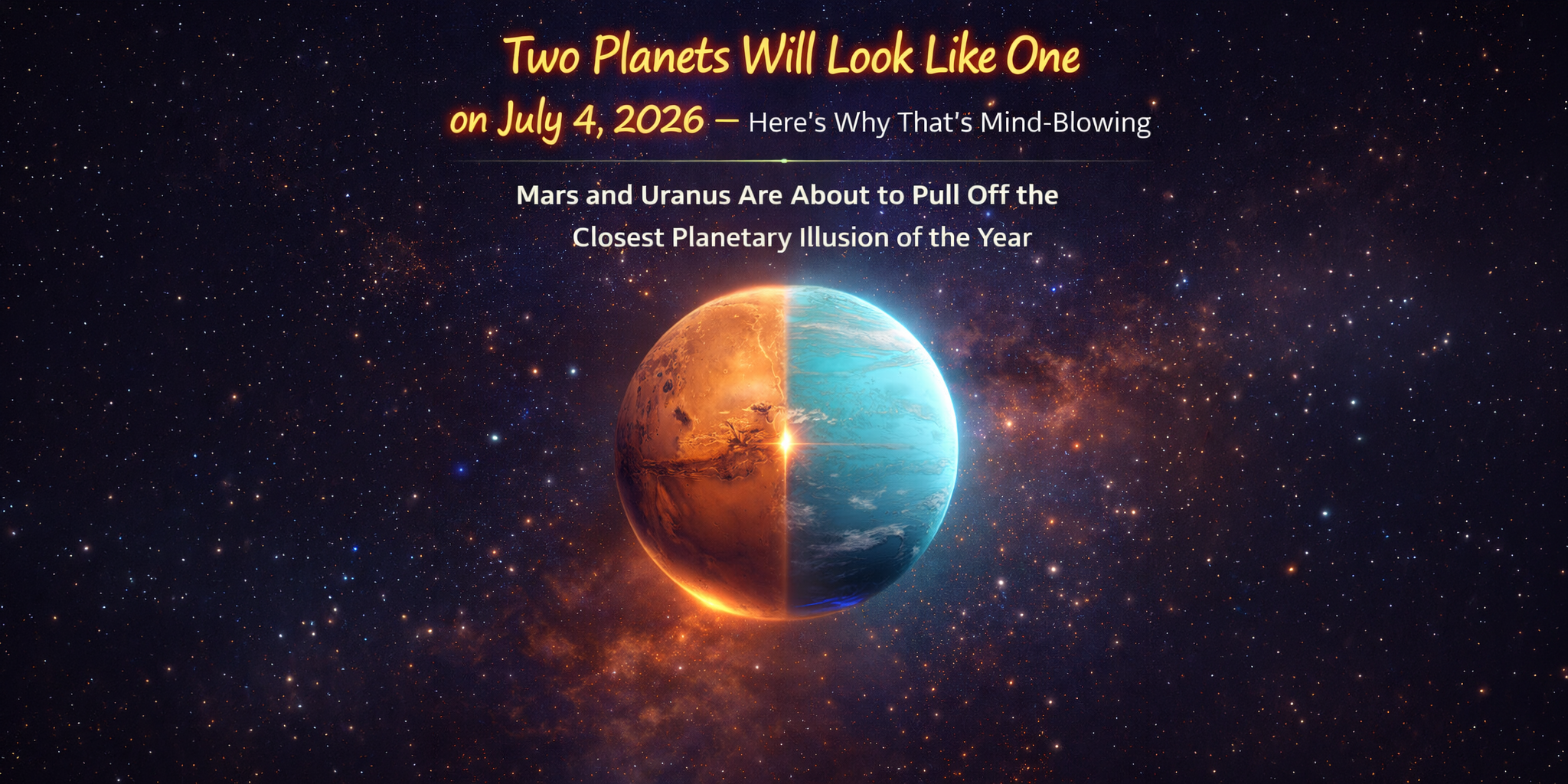
Two Planets Will Look Like One on July 4, 2026 — Here's Why That's Mind-Blowing

Mars and Uranus Are About to Pull Off the Closest Planetary Illusion of the Year

What if two completely different worlds looked like a single point of light?

On the morning of July 4, 2026, that's exactly what's happening. Mars and Uranus will appear so close together — just 0.1 degrees apart — that to the naked eye, they'll merge into one.

Except they're not even remotely close.

One is a dusty red rock 228 million kilometers from the Sun. The other is an ice giant nearly 20 times farther out, tilted sideways, wrapped in methane clouds, taking 84 years to orbit the Sun.

And for one morning, they'll appear to be the same thing.

This is what makes conjunctions so wild.

The Science of the Illusion

These two planets don't interact. They don't approach each other in space. They're just moving along their own orbits — independent, distant, and governed by the same gravitational center.

But from Earth, those paths occasionally align. And when they do, the sky compresses billions of kilometers into what looks like a single point of light.

That's not closeness. That's geometry.

And this particular geometry is rare. With only 0.1 degrees of separation, Mars and Uranus will be so close that they'll occupy nearly the same position in the sky.

What You'll Actually See

Naked eye: A single point of light. Maybe slightly elongated if you look carefully.

Binoculars: Two distinct objects. Mars glowing warm and reddish. Uranus faintly greenish-blue — that color comes from methane in its atmosphere absorbing red light.

Telescope: Even more contrast. A rocky planet shaped by volcanic activity and dust storms next to an ice giant with an atmosphere of hydrogen, helium, and methane.

Two completely different worlds. Seen side by side. Sharing the same patch of sky for a few hours.

When to Look

Best viewing: Before sunrise on July 4, 2026. Look east.

The conjunction won't last. Within hours, the separation will start growing again. Mars will continue its faster orbit, Uranus will drift slowly along its 84-year path, and the illusion will dissolve.

But for a short time, you'll see something that feels almost impossible.

Two planets. One point of light. And the quiet realization that what you're seeing isn't reality itself — but your position within it.

Sources

NASA Solar System Exploration – https://solarsystem.nasa.gov

European Southern Observatory – https://www.eso.org/public/science/