

12. August @ 10:00 pm – 13. August @ 4:00 am UTC+0
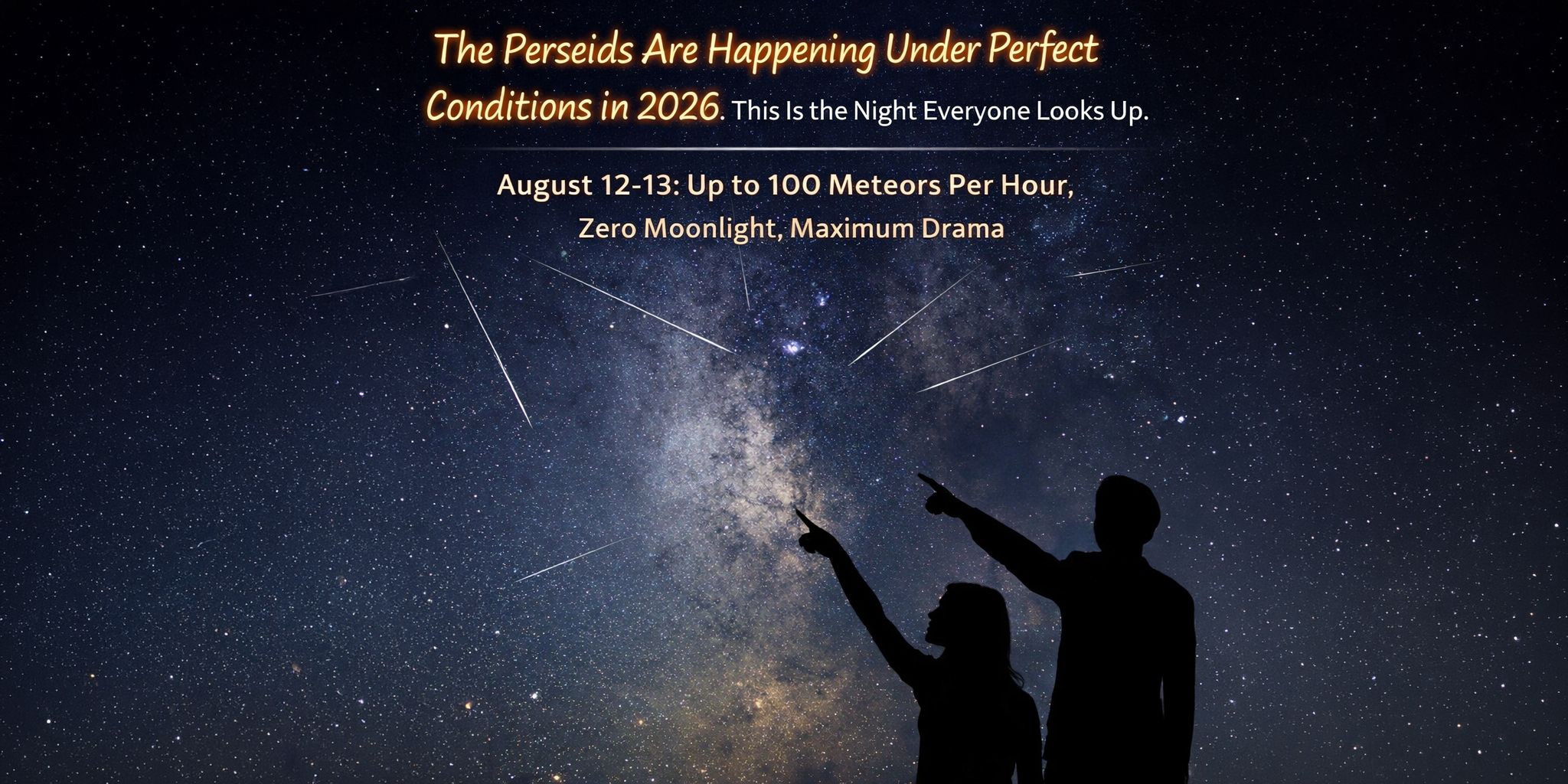
The Perseids Are Happening Under Perfect Conditions in 2026. This Is the Night Everyone Looks Up.

August 12-13: Up to 100 Meteors Per Hour, Zero Moonlight, Maximum Drama

There's one night each year when more people look up than usual.

Not because they're astronomers. Not because they understand orbital mechanics. But because, somehow, the idea has spread: this is the night when the sky comes alive.

The Perseids.

Every August, they return. Predictable, reliable, almost comforting. And yet, no two nights under the Perseids ever feel exactly the same.

On August 12-13, 2026, the peak will unfold under nearly perfect conditions. The Moon won't interfere. The sky will be dark. And for a few hours, it will feel like the universe decided to become visible again.

The Reality Is More Intense Than the Expectation

The Perseids aren't constant. They don't fill the sky in a steady stream. They come in bursts, in clusters, in moments of intensity followed by stretches of stillness.

You might see three meteors in ten seconds — and then nothing for minutes.

And in those quiet moments? Something interesting happens. You start to notice the sky itself. Your eyes adjust. The stars become sharper. The darkness deepens.

Then — streak. A line of light cuts across your vision, and for a moment, everything feels connected.

Where These Meteors Come From

The Perseids originate from Comet Swift-Tuttle, a massive comet orbiting the Sun roughly every 133 years. As it travels, it leaves behind a stream of debris — particles ranging from tiny grains to small rock fragments.

When Earth passes through this stream, those particles enter the atmosphere at up to 59 kilometers per second.

At that speed, even a grain of dust carries enormous energy. The interaction with the atmosphere produces heat, ionizes the surrounding air, and creates the bright streaks we see.

Scientifically, it's energy conversion. But from the ground? It feels like the universe is showing off.

Why 2026 Is Special

No significant moonlight. Dark skies. Under ideal conditions, 60 to 100 meteors per hour at peak activity.

But the number isn't the point.

Because what people remember isn't how many meteors they saw. It's how it felt.

Lying back. Waiting. Watching the sky without expectation. And then, suddenly, something happens — a streak of light cuts across your vision, and for a moment, everything feels connected.

How to Watch
Peak night: August 12-13, 2026

The radiant lies in the constellation Perseus, but don't stare directly at it. Let your gaze drift across the entire sky. That's where the longer, more dramatic trails appear.

Find dark skies. Give your eyes 20-30 minutes to adjust. Bring a blanket. And just look up.

That's what makes the Perseids different. Not their intensity. Not their frequency. But the way they change how you look at the sky.

And for one night each year, that change becomes something people share — even if they don't fully understand why.


Sources

NASA Meteor Showers – https://science.nasa.gov/meteors

International Meteor Organization – https://www.imo.net

ESA Science – https://www.esa.int/Science_Exploration