

27. August @ 11:00 pm – 28. August @ 4:00 am CEST
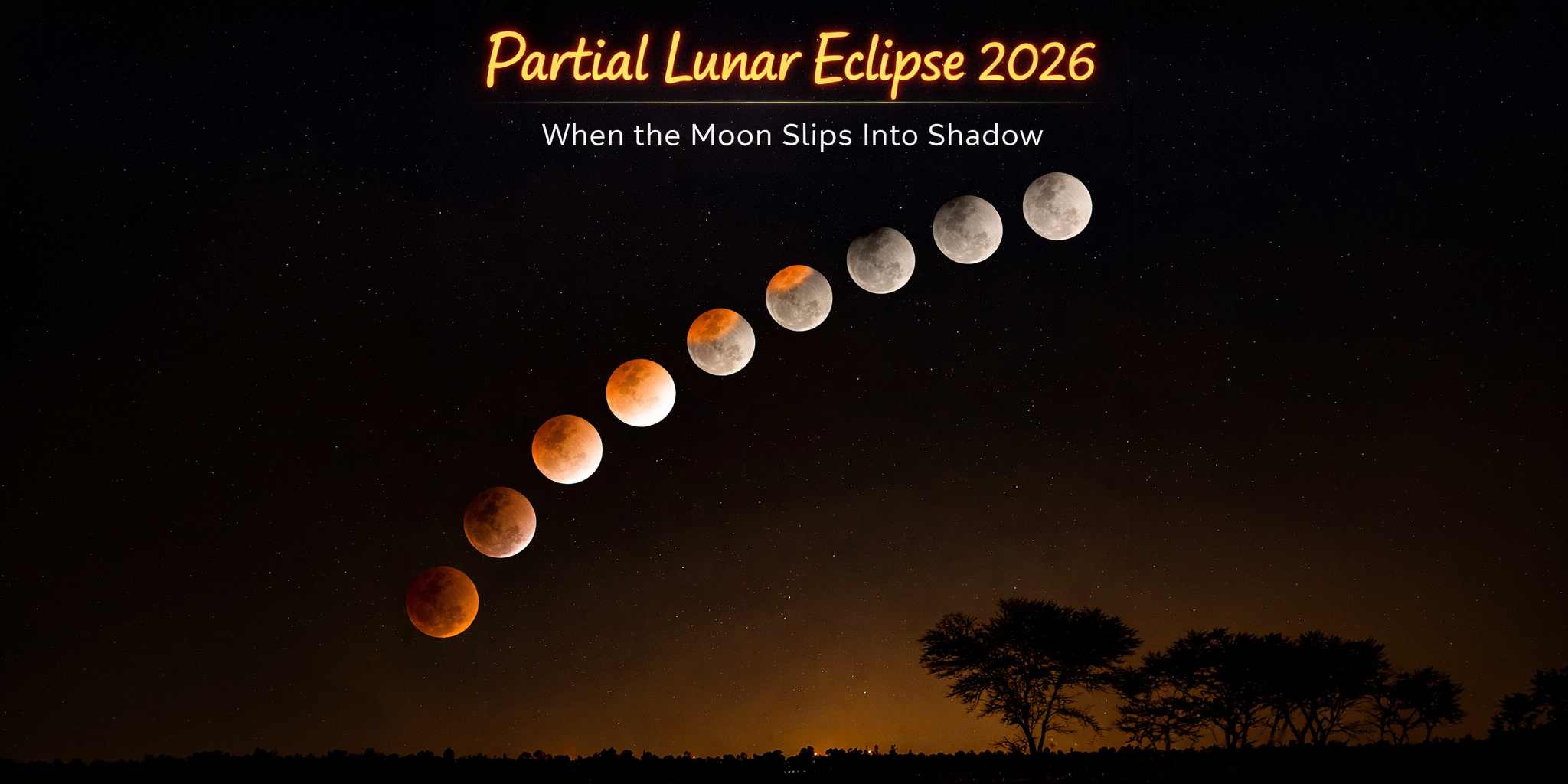
Partial Lunar Eclipse 2026 — When the Moon Slips Into Shadow

Unlike a solar eclipse, a lunar eclipse does not interrupt the day.

It doesn’t arrive suddenly. It doesn’t darken the sky or force you to stop what you’re doing and look up. Instead, it unfolds slowly — so slowly that, if you are not paying attention, you might not notice it at all.

On the night of August 27 to 28, 2026, the Moon will pass through Earth’s shadow.

Not completely.

But deeply enough that something changes.

At first, the Moon looks the same as always — bright, familiar, almost static against the background of stars. But as the eclipse begins, a subtle darkening appears along one edge. It is not sharp. Not dramatic. It is gradual.

The shadow grows.

And as it does, the Moon begins to lose its brightness.

This is what defines a lunar eclipse: not a sudden disappearance, but a slow transformation.

The Earth, positioned directly between the Sun and the Moon, casts a shadow into space. That shadow extends far beyond the planet itself, forming two distinct regions — the penumbra, where sunlight is only partially blocked, and the umbra, where the Sun is completely obscured.

During this eclipse, the Moon will move almost entirely into the umbra — about 96 percent of its surface will be covered.

And that is where things become interesting.

Because even inside Earth’s shadow, the Moon does not disappear.

It changes color.

The familiar bright white fades, replaced by a deep, muted red.

This is not because the Moon is glowing on its own.

It is because of Earth.

As sunlight passes through Earth’s atmosphere, shorter wavelengths — blues and violets — are scattered in all directions. This is the same process that makes the sky appear blue during the day.

The remaining light, dominated by reds and oranges, is bent and filtered through the atmosphere and projected into Earth’s shadow.

And that light reaches the Moon.

What you see is not the absence of light.

It is the presence of filtered light.

A reflection of all the sunrises and sunsets happening around the edge of the Earth at that moment.

This is why lunar eclipses are sometimes called “blood moons.”

But the name doesn’t quite capture the experience.

Because the change is slow.

You watch the shadow move. You watch the color shift. You watch something familiar become unfamiliar, not instantly, but over time.

And that changes how you experience it.

Unlike a solar eclipse, which demands your attention, a lunar eclipse invites it.

You can look away. You can come back. And each time you return, something has changed.

The peak of this eclipse occurs in the early hours of the morning, when the Moon is high in the sky and the shadow has reached its maximum extent.

At that point, the Moon appears darker, softer, almost detached from its usual presence.

And then, slowly, it begins to return.

The shadow recedes. The brightness comes back. The familiar shape reasserts itself.

And the sky returns to normal.

But something about the experience lingers.

Because you have watched a process unfold in real time.

You have seen the geometry of Earth, Sun, and Moon align in a way that reveals something usually hidden.

Not through sudden change.

But through gradual transformation.

And in that slow movement, something becomes clear.

Even the most stable objects in the sky are not fixed.

They are always changing.

Sometimes, we just need to wait long enough to see it.


Sources

NASA Eclipse Page – https://eclipse.gsfc.nasa.gov

European Space Agency – https://www.esa.int/Science_Exploration

International Astronomical Union – https://www.iau.org