

19. September @ 11:30 pm – 20. September @ 4:00 pm CEST
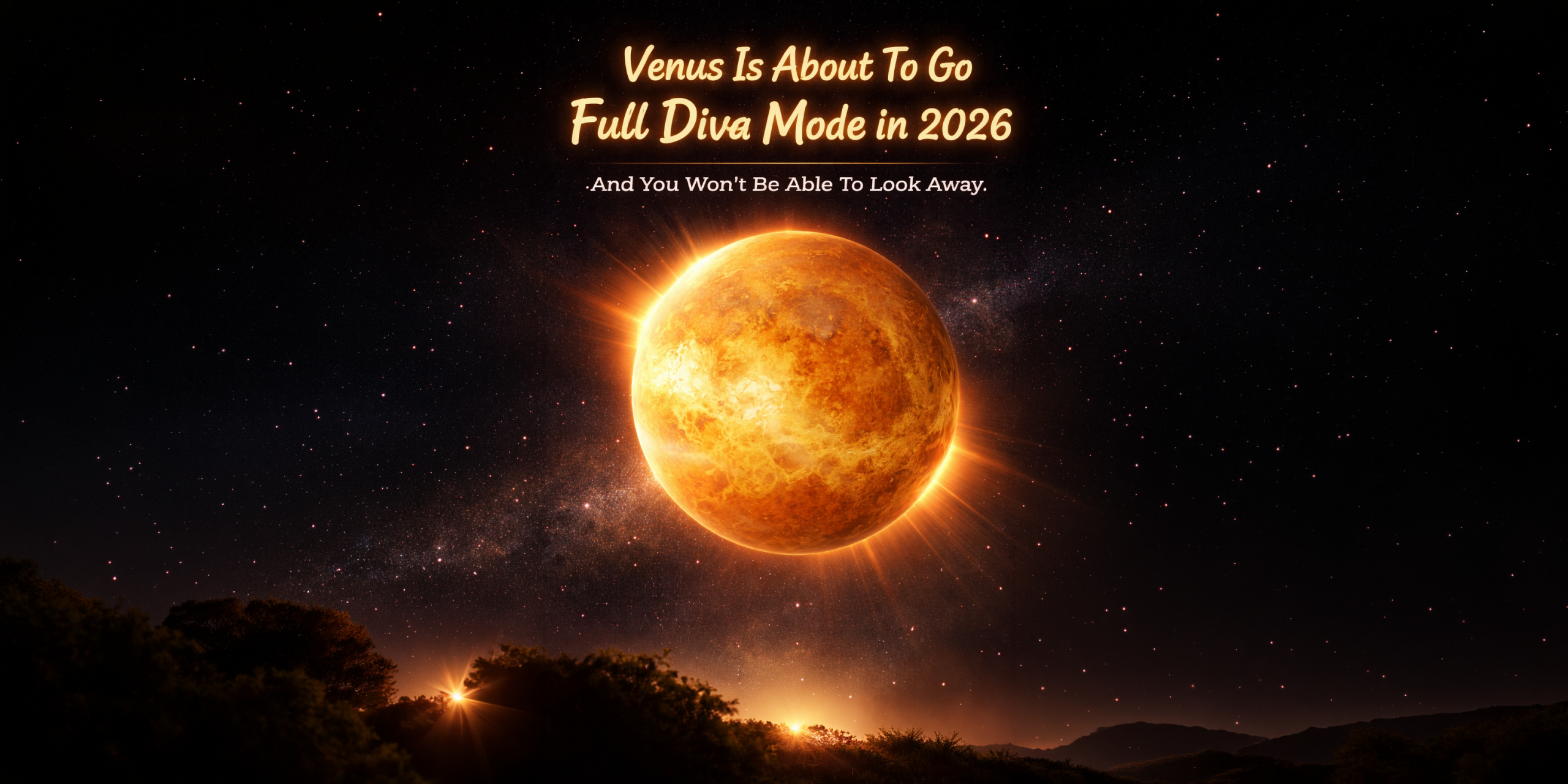
Venus Is About To Go Full Diva Mode In 2026 — And You Won't Be Able To Look Away

The planet is so ridiculously bright, people keep calling the cops thinking it's a UFO. Here's why September 2026 is going to be absolutely wild.

Look, we need to talk about Venus.

Every other celestial body plays by the rules. Stars twinkle politely in the background. The Moon shows up, does its thing, goes home. Even Jupiter, the actual largest planet in our solar system, knows how to blend in.

Venus? Venus doesn't care about your rules.

In September 2026, our chaotic neighbor reaches maximum brightness in the evening sky. We're talking SO bright that it shows up before the sun even sets. While the sky is still blue. Like some kind of celestial show-off who arrives at the party before the host is even dressed.

Why People Keep Mistaking Venus For Literally Everything Else

Here's the thing: Venus doesn't flicker. It doesn't twinkle. It just... sits there. Aggressively bright. Unsettlingly stable.

This is why emergency services regularly get calls about "strange lights" in the sky. People see this impossibly steady, impossibly bright point and think: aircraft, drone, alien spacecraft, government experiment, or (our personal favorite) "something that definitely shouldn't be there."

The explanation is beautifully simple: Venus is covered in thick clouds made primarily of sulfuric acid, and those clouds reflect approximately 70% of the sunlight that hits them. For context, Earth's average reflectivity is around 30%. Venus is basically a giant disco ball in space.

The Science That Makes This Whole Thing Even Cooler

Here's where it gets interesting (yes, MORE interesting).

Venus orbits closer to the Sun than Earth does. This means it never wanders far from the Sun in our sky — it's always either the "evening star" after sunset or the "morning star" before sunrise.

At maximum brightness, Venus isn't at its closest point to Earth, and it's not fully illuminated either. Instead, it appears as a crescent — like a tiny version of a crescent Moon. This specific combination of crescent phase and distance creates peak brightness.

Point a telescope at it and prepare to have your mind slightly rearranged.

You'll see that Venus isn't just a point of light. It's a shape. A phase. A literal world — one with an atmosphere so dense it creates surface temperatures hot enough to melt lead (around 465°C / 869°F).

From 41 million kilometers away, it looks like the simplest thing in the sky. Up close, it's one of the most hostile environments in our solar system.

That contrast? That's the whole point.

Venus doesn't behave like everything else in the night sky. It arrives early. It shines too bright. And it makes you look up.

Sometimes that's all it takes.


Sources

NASA Solar System Exploration — https://solarsystem.nasa.gov

European Southern Observatory — https://www.eso.org/public/science/

ESA Science — https://www.esa.int/Science_Exploration