

5. October @ 11:00 pm – 6. October @ 3:00 pm CEST
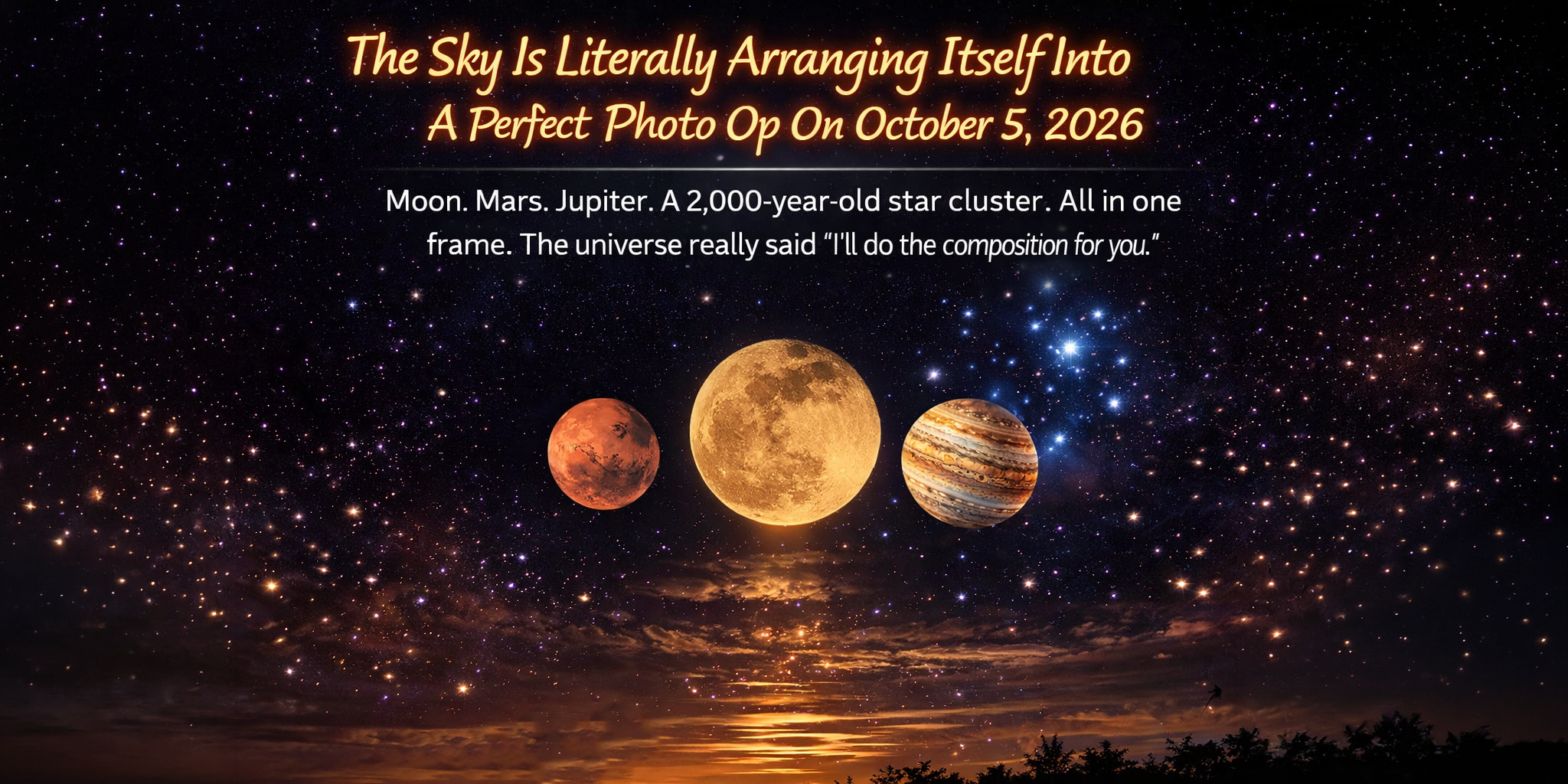
The Sky Is Literally Arranging Itself Into A Perfect Photo Op On October 5, 2026

Moon. Mars. Jupiter. A 2,000-year-old star cluster. All in one frame. The universe really said 'I'll do the composition for you.'

Some nights, the sky looks like a mess of random dots.

And then there are nights where it looks like someone opened Photoshop, dragged four celestial objects into frame, and hit 'align to grid.'

October 5, 2026, just before sunrise, is that kind of night.

Here's the lineup: The waning Moon drifts close to Mars in the constellation Cancer. Just below them sits Praesepe — also known as the Beehive Cluster — a grouping of stars that humans have been staring at since ancient Greece. And a little farther out? Jupiter, anchoring the whole scene like the main character it knows it is.

Four different objects. Four different distances. Four different orbital mechanics.

One impossibly beautiful alignment.

What Each Object Brings To The Party

The Moon: Brightness and reference. Your eye goes here first. It's the visual anchor.

Mars: Color. That warm, reddish glow that pops against the cooler tones of everything else. Instant contrast.

Praesepe: Texture. A soft, diffuse cluster that adds depth. With dark skies or binoculars, it resolves into dozens of individual stars. It's been catalogued since at least 260 BCE.

Jupiter: The stabilizer. Brighter than most stars, steady, unmistakable. It doesn't try to compete — it just shows up and owns the frame.

Together? They create a layered view of the solar system and beyond.

The Distance Thing Will Break Your Brain

Let's talk scale, because it's genuinely absurd:

The Moon is about 384,000 km away — your nearest celestial neighbor.

Mars is roughly 200 million km away (depending on orbital positions).

Jupiter sits at about 600-900 million km.

And Praesepe? About 577 light-years. That's roughly 5.5 quadrillion kilometers.

All of them appearing in a single field of view.

Your brain isn't built for this. And that's exactly what makes it special.

Grab Binoculars And Watch Everything Level Up

Naked eye? You'll see contrasts — brightness versus faintness, color versus neutrality, movement versus stillness.

Binoculars or telescope? The experience transforms:

Praesepe dissolves into dozens of individual stars. Mars becomes a defined disk. The Moon reveals its surface texture. And Jupiter might even show you its moons — tiny points of light arranged around the planet like its own miniature solar system.

What looked simple suddenly becomes complex. What looked flat reveals depth.

This is not a picture. It's a perspective.

A single viewpoint through a vast, three-dimensional structure that just happens to look arranged — for one brief, perfect morning.

Then the Moon moves on. Mars shifts. The composition dissolves.

But for that moment? The universe looks like it actually tried.

Sources

NASA Solar System Exploration — https://solarsystem.nasa.gov

European Southern Observatory — https://www.eso.org/public/science/

ESA Science — https://www.esa.int/Science_Exploration