

24. October @ 11:00 pm – 25. October @ 2:30 am CEST
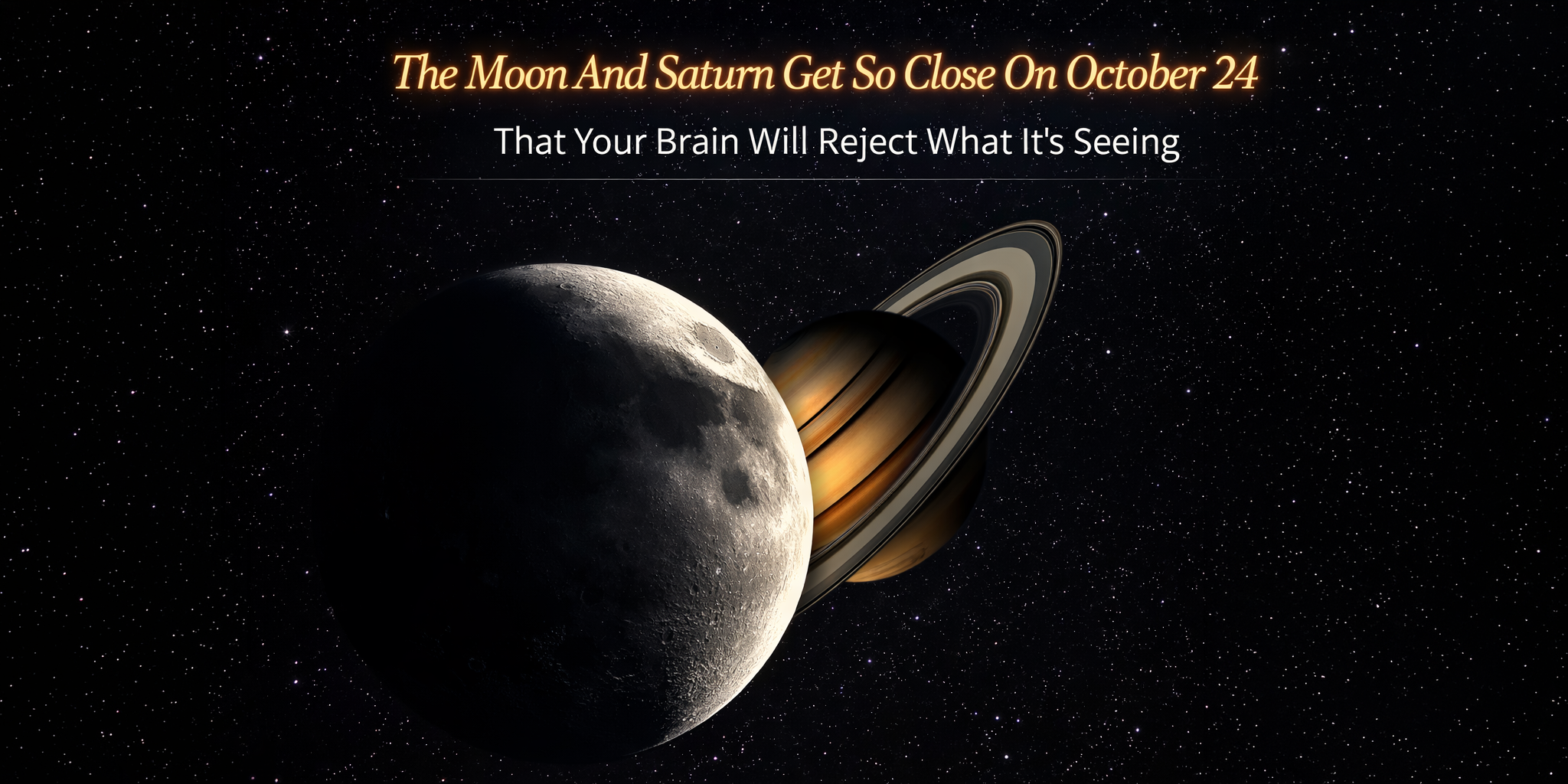
The Moon And Saturn Get So Close On October 24 That Your Brain Will Reject What It's Seeing

Less than one degree apart. Over a billion kilometers of actual distance. Your visual cortex is about to have a meltdown.

You're going to look up and think something's wrong.

Not in an apocalyptic, end-times way. More like that subtle feeling when your brain registers something that doesn't fit the pattern it expected.

Because on October 24, 2026, the Moon and Saturn will appear EXTREMELY close — less than one degree apart.

For reference: your thumb at arm's length covers about one degree of sky. These two will fit behind your thumb. Together.

And your brain is going to hate it.

The Math Is Genuinely Absurd

The Moon is about 384,000 km away. Close enough that you can see craters, shadows, and surface detail with your naked eyes.

Saturn is about 1.4 BILLION kilometers away. That's not "far." That's "my brain refuses to process this number" far.

Light from Saturn takes over an hour to reach you. When you see Saturn, you're seeing where it was 70+ minutes ago.

And yet, on this night, they share the same patch of sky. Same direction. Same visual frame.

Almost touching.

This is what happens when you flatten 3D space into a 2D view. Things that are nowhere near each other suddenly look like neighbors.

Why Your Brain Keeps Falling For This

Your brain evolved on the African savanna. It's wired to interpret closeness as connection. If two things are next to each other, they must BE near each other.

That works great on Earth. In a forest. On a plain. In a city.

It completely fails in space.

What you're seeing is a projection — a billion kilometers of depth, crushed into a flat image. The Moon moves quickly (about 13 degrees per day). Saturn barely moves at all against the background stars.

So when the Moon passes near Saturn, it creates this temporary, impossible-looking alignment. And your brain says: "That can't be right."

But it is. It's just not what you think it is.

Naked Eye vs. Telescope: Two Completely Different Shows

Naked eye: The Moon dominates. Bright, detailed, almost overwhelming. Saturn sits next to it — steady, slightly golden, refusing to flicker like stars. You'll notice it looks "different." More stable. That's your clue that it's not a star.

Telescope: Everything changes. The Moon becomes a landscape — craters, ridges, shadows in high contrast. And Saturn? It reveals its rings. That impossible, thin structure wrapping around the planet.

Two completely different worlds. One raw and detailed. One distant and structured.

Seen at the same time. In the same direction. Less than one degree apart.

The Unfamiliar Feeling Is The Point

This event doesn't just show you objects. It breaks your sense of scale.

It forces you to accept that distance doesn't behave the way you think it does. That things can look connected without being connected at all.

For a moment, the sky feels wrong.

Not broken. Just... unfamiliar.

And that unfamiliarity? That's where curiosity starts.

October 24, 2026. Look up. Let your brain struggle.

That's the experience.

Sources

NASA Solar System Exploration — https://solarsystem.nasa.gov

European Southern Observatory — https://www.eso.org/public/science/

ESA Science — https://www.esa.int/Science_Exploration