

7. November @ 11:00 pm – 8. November @ 3:30 pm CET
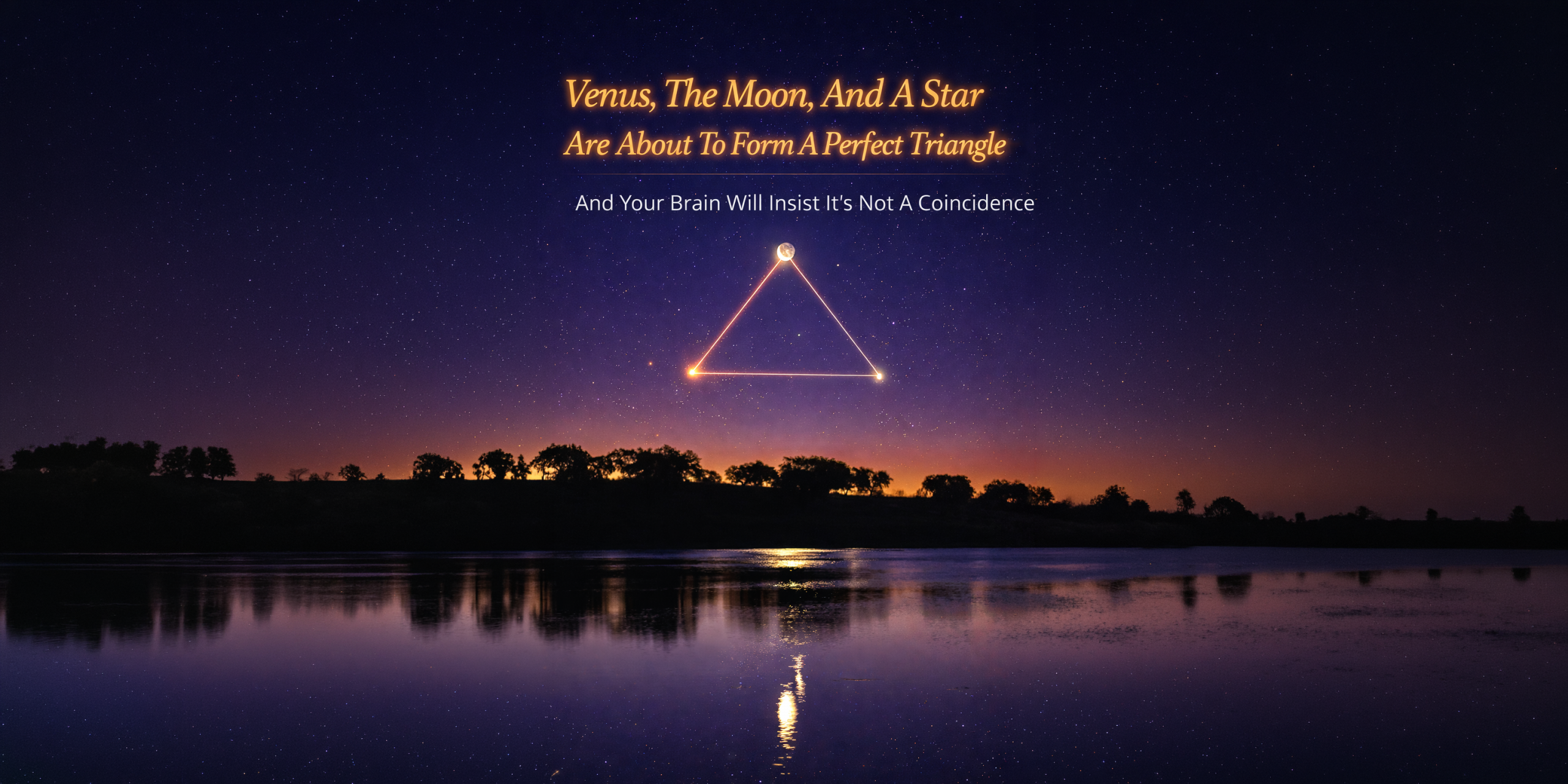
Venus, The Moon, And A Star Are About To Form A Perfect Triangle — And Your Brain Will Insist It's Not A Coincidence

November 7, 2026. Three cosmic objects. One geometrically perfect shape. Zero actual connection between them.

Sometimes the sky looks random.

And sometimes it looks like someone literally drew a shape up there.

On the morning of November 7, 2026, three objects will line up in a way that feels almost too clean to be natural: Venus, a thin crescent Moon, and Spica — one of the brightest stars in the constellation Virgo.

Together, they form a near-perfect triangle.

And your first thought will be: "There's no way that's a coincidence."

But it is.

And it isn't.

The Cast Of Characters

Venus: The main character. Blindingly bright. The kind of bright that doesn't belong in a morning sky. It cuts through twilight, visible even before the sky fully darkens. It doesn't flicker. It doesn't blend in. It just sits there — steady, almost artificial.

The Moon: A thin crescent, delicate, almost fragile compared to Venus. The illuminated edge is sharp, but most of the Moon is still visible — faintly glowing through Earthshine (sunlight reflecting off Earth and back onto the lunar surface). It's a subtle, ghostly detail.

Spica: The quiet one. A massive, hot star about 250 light-years away, shining with a blue-white color that contrasts with the warmer tones of Venus and the Moon. Easy to ignore if you're not paying attention.

Three completely different objects. Three completely different scales. Three completely different distances.

And yet, they fit together. Perfectly.

Why Your Pattern-Seeking Brain Can't Handle This

Here's your brain's problem: It wants patterns to MEAN something.

Triangles feel intentional. Structured. Designed.

You see three points arranged in a geometric shape and some ancient wiring fires up: "This was placed here. This is significant."

But in space, patterns are temporary.

The Moon is moving fast — about 13 degrees across the sky every day. Venus moves more slowly, tracing its orbit closer to the Sun. Spica doesn't move at all in any noticeable way — it's about 250 light-years away, or roughly 2.4 quadrillion kilometers.

So this alignment is fragile. It exists for a moment. And then it's gone.

The universe isn't designing anything. It's just moving. And occasionally, from our very specific position in space, things line up.

How To Actually Watch This

When: Morning of November 7, 2026. Pre-dawn. Eastern sky.

What you need: Your eyes. That's it. Though binoculars make the spacing and angles even clearer.

What you'll see: Venus will be impossible to miss. The crescent Moon will be delicate and thin, with its dark side faintly glowing from Earthshine. Spica will be the subtle blue-white point completing the triangle.

And for a moment, the sky will look composed. Balanced. Almost like someone arranged it.

The Point Is The Feeling

This isn't about brightness. It isn't about rarity.

It's about the fact that it triggers something in you.

Because you're wired to recognize patterns. To assign meaning. To think: "This looks right."

Even when it's just physics.

Most of the sky is ignored. Until something like this happens. A simple shape. Three points. And for a moment, everything feels connected.

Even if it isn't.

November 7, 2026. Look east. Let geometry mess with your head.

Sources

NASA Solar System Exploration — https://solarsystem.nasa.gov

European Southern Observatory — https://www.eso.org/public/science/

ESA Science — https://www.esa.int/Science_Exploration