

13. December @ 11:00 pm – 15. December @ 3:00 am CET
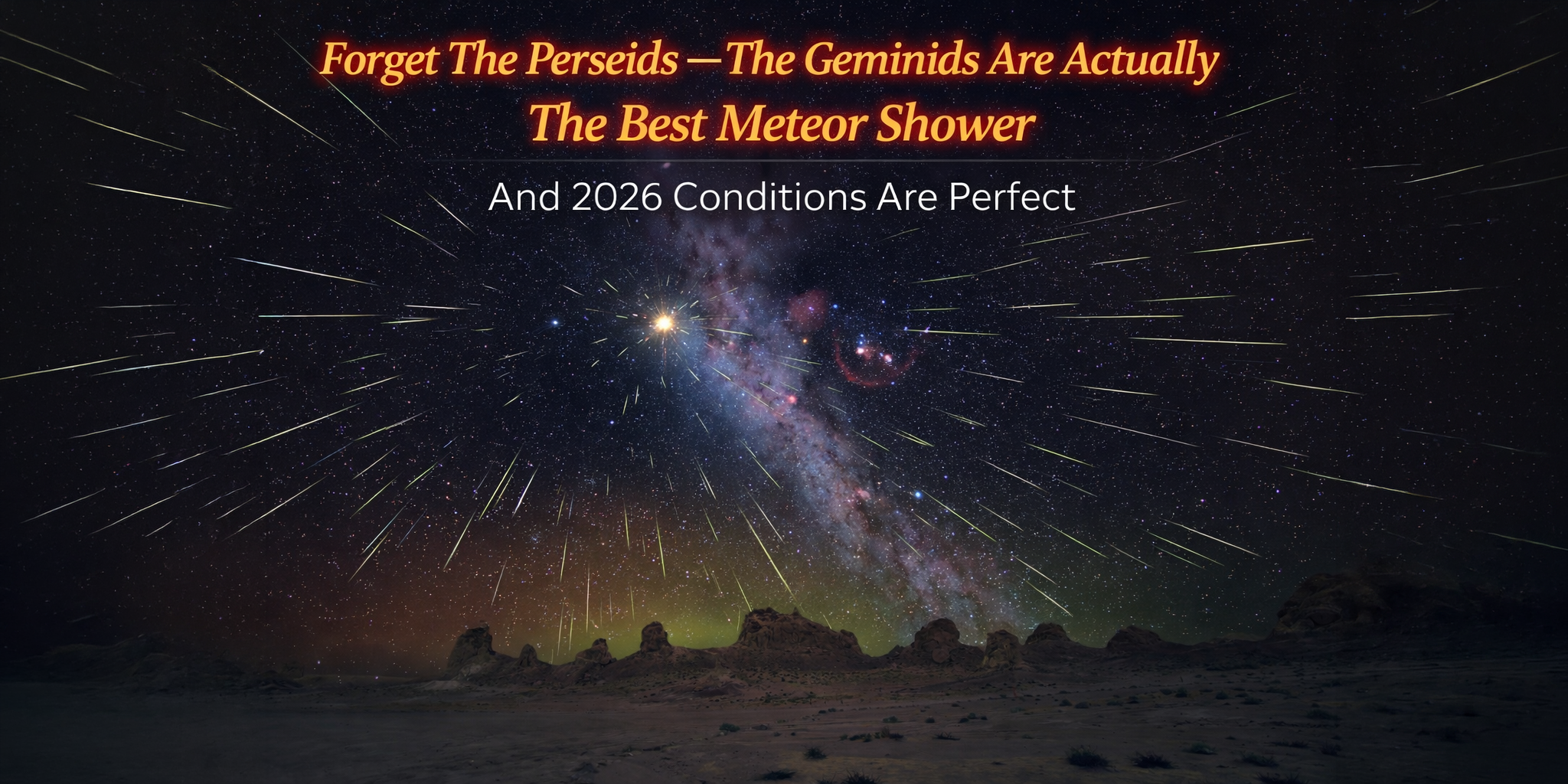
Forget The Perseids — The Geminids Are Actually The Best Meteor Shower And 2026 Conditions Are Perfect

100+ meteors per hour. No Moon interference. December 13-14. This is the one.

If you've only watched one meteor shower in your life, there's a good chance it wasn't the best one.

Because despite the hype around the Perseids, the Geminids are actually the most intense meteor shower of the year.

And in 2026, they show up under near-perfect conditions.

No bright Moon. Peak activity around December 13-14. And the potential for OVER 100 METEORS PER HOUR under dark skies.

That's not marketing. That's physics.

The Origin Story Is Absolutely Wild

Most meteor showers come from comets — icy bodies that shed dust as they approach the Sun.

The Geminids don't.

They come from an object called 3200 Phaethon. And Phaethon is weird.

It behaves like an asteroid. Rocky. Dense. No classic comet tail. And yet, it produces one of the most active meteor streams in the solar system.

Scientists classify it as a "rock comet" — an object that releases material not through ice sublimation, but through THERMAL FRACTURING. As it approaches the Sun, its surface heats up to extreme temperatures, causing rock to crack and eject particles into space.

So you're watching pieces of a cracking asteroid burn up in our atmosphere. That's metal.

Why These Meteors Look Different

Geminid meteors enter the atmosphere at about 35 km/s — slower than many other showers (like the Leonids at 71 km/s).

That lower speed changes how they appear:

Bright, often colorful streaks. More visible. More trackable. More noticeable.

The sky doesn't just have occasional flashes. It becomes a continuous sequence of events.

And in 2026, with minimal moonlight, the contrast is STRONG.

The Best Part: You Don't Have To Destroy Your Sleep Schedule

Unlike many meteor showers that peak just before dawn (because nature hates us), the Geminid radiant rises earlier in the evening.

Which means you can start observing BEFORE midnight.

No 3 AM alarm. No existential crisis about whether staying up is worth it. No falling asleep on a blanket in the cold.

Just go outside around 10 PM, look up, and watch the sky do its thing.

That accessibility turns a "rare astronomical event" into something almost anyone can experience.

And when you do, it doesn't feel subtle. It feels active. Alive. Because for a few hours, the sky isn't static.

It's moving. Constantly.

And once you see that, it's hard to go back to thinking of the night sky as quiet.

Sources

NASA Meteor Showers — https://science.nasa.gov/meteors

International Meteor Organization — https://www.imo.net

Peer-reviewed: Jewitt & Li (2010), 'Activity in Geminid Parent 3200 Phaethon', AJ Journal