

18. December @ 11:00 pm – 19. December @ 3:30 am CET
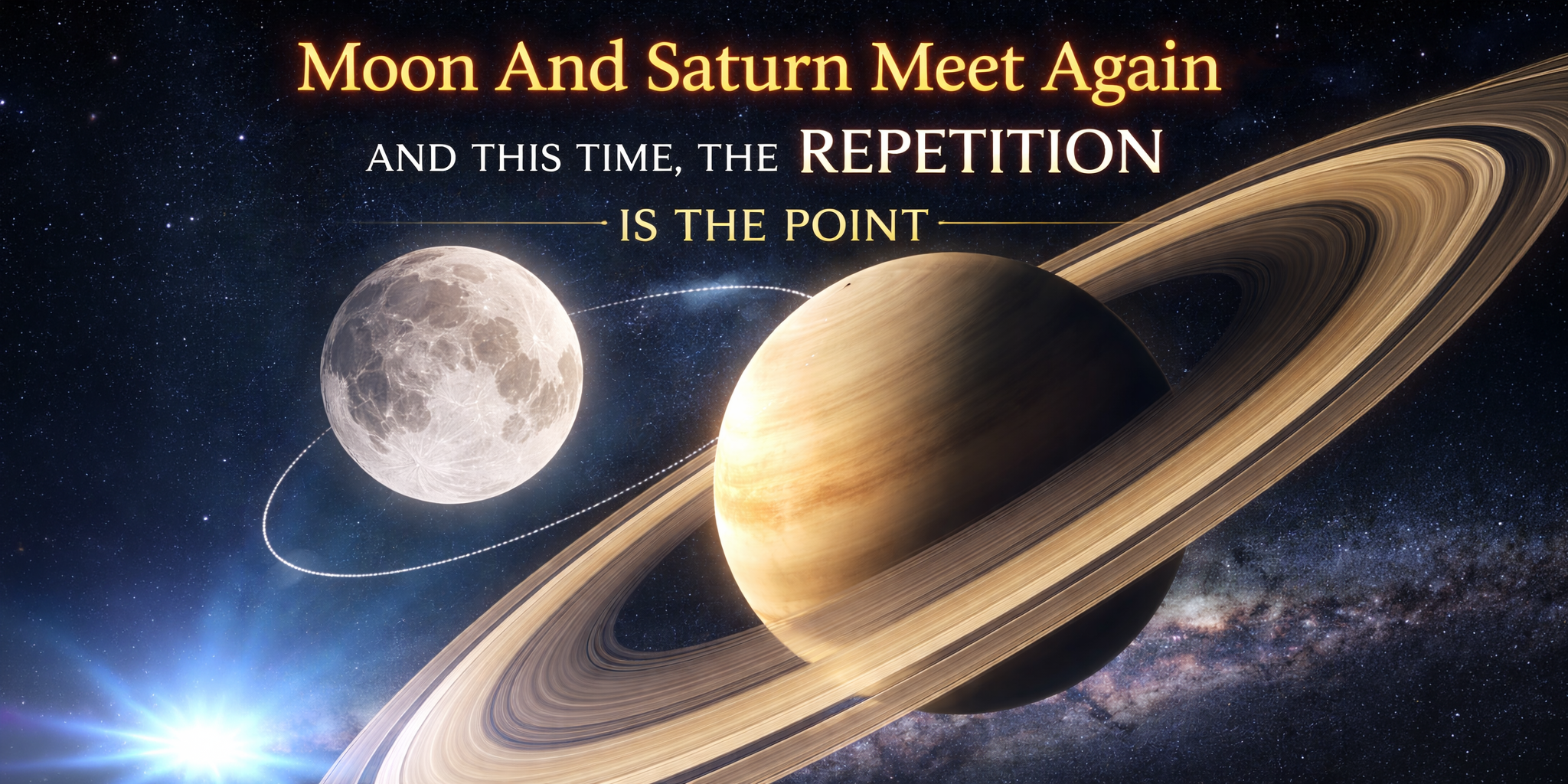
Moon And Saturn Meet Again — And This Time, The Repetition IS The Point

December 18, 2026: You've seen this before. That's exactly why it matters now.

By now, you've seen this before.

The Moon near Saturn. Two objects, seemingly close. Two points that instantly draw your attention.

And yet, something about this one feels different.

On December 18, 2026, the Moon once again appears close to Saturn in the evening sky. It's not the first time this year. It's not even the closest.

But that's exactly why it matters.

Repetition Changes How You See Things

The first time you see a conjunction like this, it feels surprising. Unexpected. Two worlds appearing side by side.

By the third or fourth time? Something shifts.

You start to understand it. Not just intellectually. VISUALLY.

You recognize the pattern. You expect the alignment. And that changes the experience from "wow" to something more subtle. Something deeper.

Because now, you're not just seeing the event. You're seeing the MOTION behind it.

The Moon, moving quickly along its orbit, catching up to Saturn again and again. Saturn, barely moving in comparison. Stable. Distant. Almost fixed.

The Moon passes. Saturn remains.

And over time, that repetition reveals structure. Not randomness. But rhythm.

This Is The Transition That Changes Everything

This is one of the most important transitions in astronomy:

The moment when the sky stops being a collection of events and becomes a SYSTEM.

Because once you notice repetition, you start to predict. You start to anticipate.

And that's when observation becomes understanding.

The View Is Still Gorgeous

Visually, the scene is still striking. The Moon, a thin crescent again, hangs low in the evening sky. Soft light. Sharp edge. Earthshine faintly visible.

And Saturn sits nearby, dimmer but distinct. Steady. Unflickering.

If you use a telescope, the contrast remains powerful. The Moon reveals its surface. Saturn reveals its rings.

But by now, you already know that.

And that's the difference. This time, it's not about discovering something new. It's about recognizing something familiar.

And realizing that familiarity doesn't reduce the experience.

It deepens it.

Because repetition isn't boring. It's how patterns become visible. And once you see those patterns, the sky stops feeling random.

It starts to make sense.

And that's a different kind of awe. Less immediate. But much more lasting.

Sources

NASA Solar System Exploration — https://solarsystem.nasa.gov

European Southern Observatory — https://www.eso.org/public/science/

ESA Science — https://www.esa.int/Science_Exploration