

27. September @ 11:00 pm – 28. September @ 4:00 am CEST
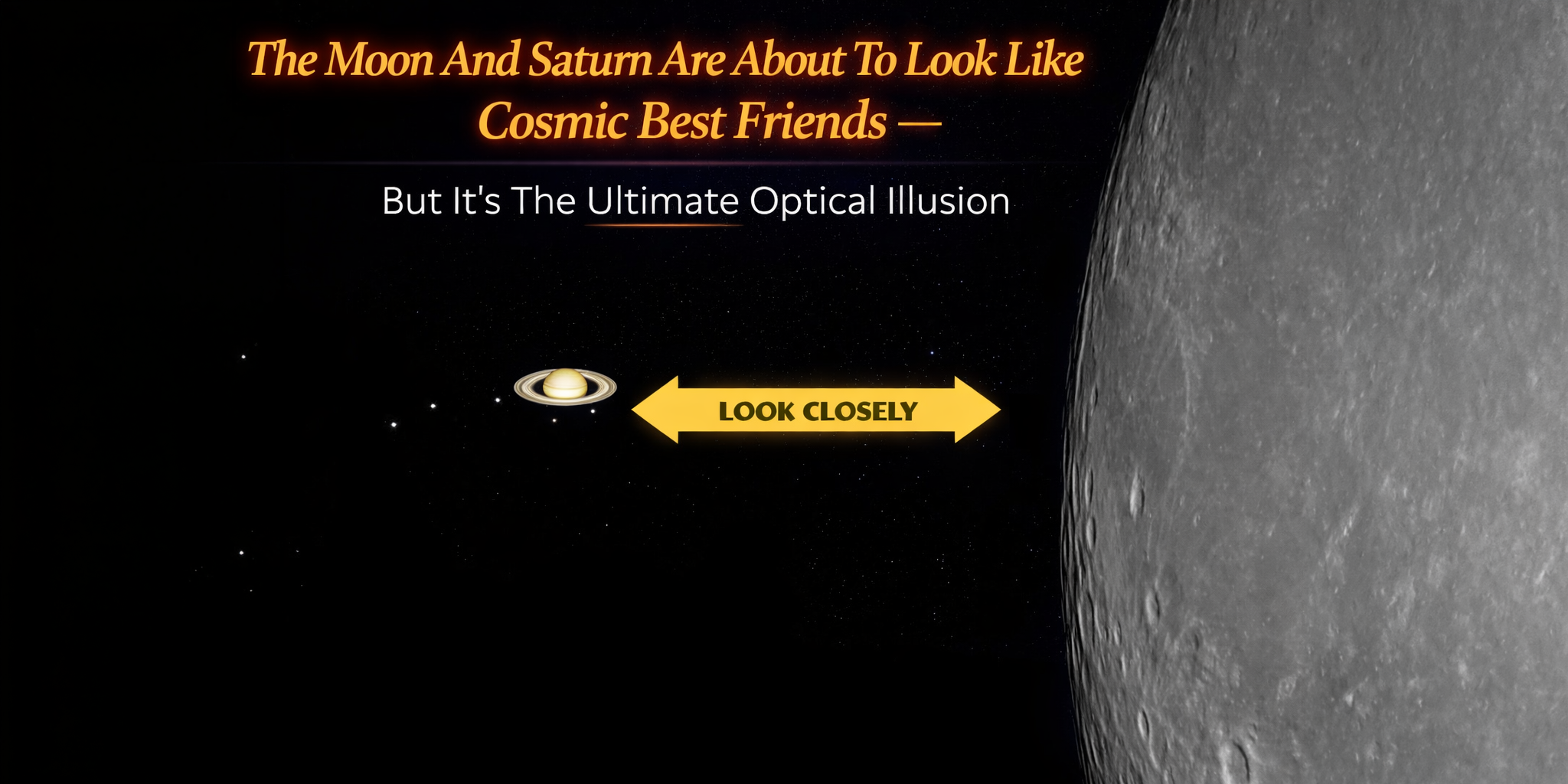
The Moon And Saturn Are About To Look Like Cosmic Best Friends — But It's The Ultimate Optical Illusion

On September 27, 2026, the sky is going to mess with your sense of reality. In the best way possible.

Picture this: You look up at the night sky and see the Moon. Right next to it, so close they look like neighbors, is Saturn.

Cute, right? Two celestial bodies hanging out. Friendship goals.

Except here's the thing: They're not even remotely close.

The Moon is approximately 384,000 kilometers from Earth. Saturn? Over one BILLION kilometers away. The light from Saturn takes more than an hour to reach your eyes.

What you're seeing isn't proximity. It's alignment. It's perspective. It's the universe playing tricks on your pattern-seeking primate brain.

And honestly? It's spectacular.

What You'll Actually See (No Telescope Required)

The Moon will be bright, detailed, and dramatic. With just your naked eyes, you'll spot craters, shadows, the whole lunar personality on display.

Saturn? Saturn will be a steady point of light. No rings visible. No details. Just a quiet, stable glow that refuses to twinkle like the stars around it.

They'll look like they belong together. Like they're in the same zip code of space.

They are not.

Now Add A Telescope And Watch Your Mind Break

Point a telescope at this cosmic duo and the contrast becomes almost absurd.

The Moon fills your entire field of view with mountains, craters, and shadows. It's a landscape. It's practically begging for a National Geographic documentary.

Swing over to Saturn — appearing so "close" in the same sky — and suddenly you're looking at its famous rings. Thin, delicate, tilted just enough to be visible. A completely different world, in a completely different context, looking like it's just next door.

Two completely different experiences. Same night. Same sky.

Why Your Brain Falls For This Every Single Time

Here's what's actually happening: The sky isn't flat. It isn't layered neatly like a PowerPoint presentation. It's three-dimensional space, and you're looking through it from a single, fixed point.

Your brain, evolved for survival on the African savanna, was never designed to process billion-kilometer distances. So it takes a shortcut. It says: "Close together? Must be close."

It's not lazy. It's efficient. But it's also very, very wrong.

This alignment won't last. Within hours, the Moon continues its orbit, visibly shifting even during a single night. Saturn stays almost fixed — its apparent motion is way slower.

The cosmic friendship ends. The hierarchy of distance returns.

But for one night, the sky offers a reminder: What you see is not always what is.

And sometimes two objects can feel impossibly close — even when separated by distances your brain cannot truly comprehend.

Sources

NASA Solar System Exploration — https://solarsystem.nasa.gov

European Southern Observatory — https://www.eso.org/public/science/

ESA Science — https://www.esa.int/Science_Exploration