

26. September @ 11:00 pm – 27. September @ 3:30 am CEST
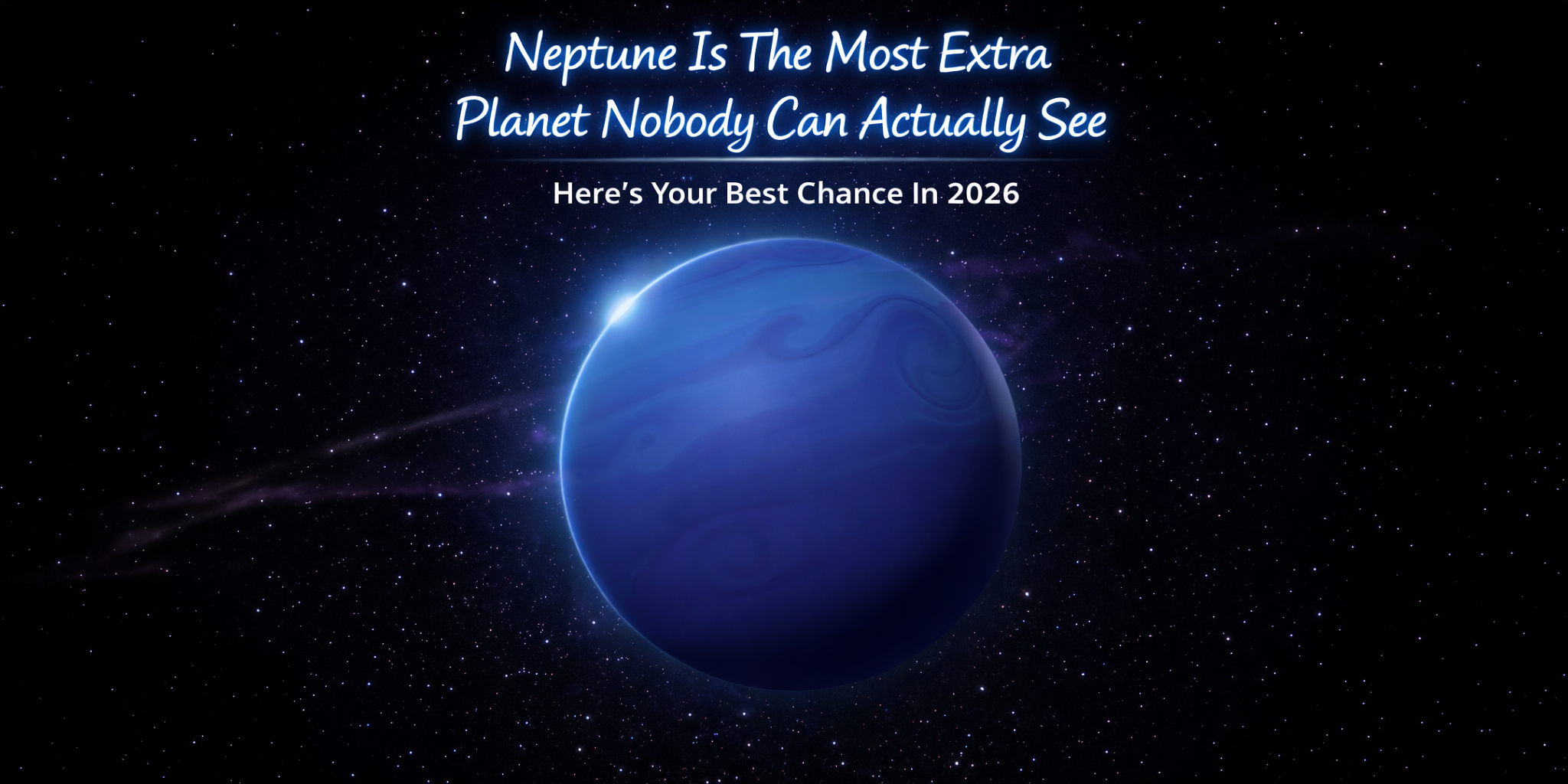
Neptune Is The Most Extra Planet That Nobody Can Actually See — Here's Your Best Chance In 2026

This distant ice giant is playing the ultimate game of hard-to-get, and September 26, 2026 is basically your only shot.

There's a whole planet out there that most people will never see with their naked eyes.

Read that again.

An entire planet.

Neptune exists at the absolute edge of our solar system, 4.5 billion kilometers away, quietly doing its thing while literally nobody watches. It's the astronomical equivalent of that indie band that's actually incredible but nobody's heard of because they refuse to play Spotify's algorithm game.

On September 26, 2026, Neptune reaches opposition. In astronomy speak, this means Earth sits directly between Neptune and the Sun. The planet rises at sunset, peaks at midnight, and sets at sunrise.

It's as good as Neptune gets. And here's the wild part: it's still basically invisible.

The Numbers Are Absolutely Unhinged

Neptune's apparent magnitude is around 7.8. The human eye, under absolutely perfect conditions, can detect objects down to about magnitude 6. Neptune misses the cutoff.

With any light pollution — which is basically everywhere now — you need binoculars minimum. A telescope helps. And even then, Neptune appears as a small, faint disk with a subtle blue-ish color.

Nothing about it screams "look at me."

And that's exactly what makes it fascinating.

You're Literally Looking Into The Past

Light from Neptune takes over four hours to reach Earth.

When you finally spot that tiny blue dot through your telescope, you're not seeing Neptune as it is now. You're seeing Neptune as it was four hours ago. The light hitting your eyes left the planet while you were maybe eating lunch.

The blue color, by the way, comes from methane in Neptune's atmosphere. Methane absorbs red wavelengths and reflects blue ones back. The atmosphere itself is absolutely chaotic — wind speeds reach over 2,000 kilometers per hour, faster than anything on Earth.

But none of that is visible to us. All we get is a faint point. Blue-ish. Distant. Easy to miss entirely.

Why This Actually Matters

Neptune represents the edge of what we can perceive from Earth. It's a reminder that the universe doesn't adjust itself for our convenience. Some things require effort. Tools. Patience. Intention.

On the night of opposition, Neptune is as accessible as it will be all year.

Still subtle. Still quiet. Still almost hidden.

But if you take the time to find it — that small, faint point among thousands of stars — something shifts.

Seeing is not about brightness. It's about awareness.

And sometimes the most distant things are the ones that require you to look the closest.

Sources

NASA Solar System Exploration — https://solarsystem.nasa.gov

European Southern Observatory — https://www.eso.org/public/science/

ESA Science — https://www.esa.int/Science_Exploration