

15. November @ 11:00 pm – 16. November @ 3:30 am CET
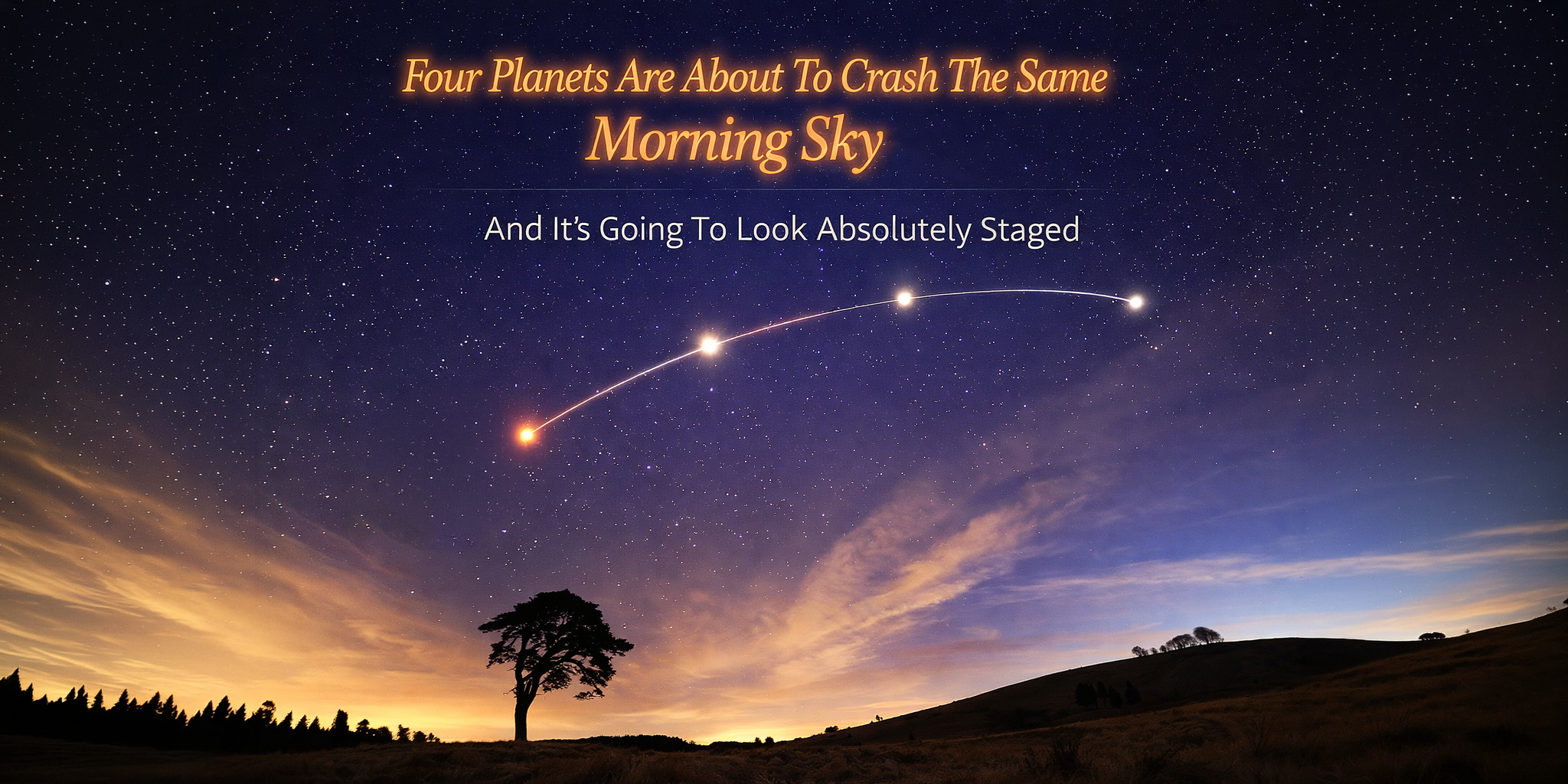
Four Planets Are About To Crash The Same Morning Sky — And It's Going To Look Absolutely Staged

Jupiter, Mars, Venus, Mercury. All visible. Same sky. November 15, 2026 is basically a planetary group photo.

Some mornings, the sky feels empty.

And some mornings, you look up and think: "Wait, is the solar system having a staff meeting?"

November 15, 2026 is that kind of morning.

Before sunrise, if you look toward the horizon, you're not going to see one planet. You're going to see FOUR. Jupiter and Mars sitting about one degree apart (that's ridiculously close). Venus higher up, glowing like it owns the place. And Mercury, low on the horizon, playing hard to get but definitely present.

Suddenly, the sky doesn't feel random anymore.

It feels populated. Almost staged. Like someone arranged this.

The 'Planet Parade' Is Real — The Alignment Is Not

Let's clear something up: They're NOT actually lining up.

They just LOOK like it.

Here's why: All planets orbit the Sun in roughly the same plane — called the ecliptic. From Earth, that plane appears as a line across the sky. So when multiple planets are visible at once, they naturally fall along that line.

Which creates the ILLUSION of alignment.

But the distances? Completely different.

Venus is relatively close. Mercury is closer still. Mars is farther. Jupiter is MUCH farther. They're not interacting. They're not forming a system. They're just sharing your line of sight.

But your brain doesn't care about that. Your brain sees a pattern. A grouping. Something that feels intentional.

And honestly? That's enough.

What Each Planet Brings To The Show

Jupiter: The headliner. Bright, steady, impossible to ignore. It dominates the scene like it knows exactly what it's doing.

Mars: The contrast. Dimmer than Jupiter, but unmistakably red. Sitting about one degree away — close enough to look like they're hanging out together.

Venus: The scene-stealer. Higher in the sky, glowing like it doesn't belong. Venus never behaves like a normal planet and this morning is no exception.

Mercury: The elusive one. Low on the horizon, harder to spot, but there if you know where to look. Mercury is always playing hard to get — it never strays far from the Sun.

Grab Binoculars And Watch Them Transform

Naked eye? You see points arranged across the sky. Impressive, but flat.

Binoculars or telescope? Everything transforms:

Jupiter reveals its moons — tiny points of light arranged around it like its own miniature solar system. Mars becomes a small disk. Venus, depending on its phase, shows a crescent.

Each object transforms from a point into a world.

And suddenly, the sky doesn't feel like a backdrop. It feels like a system. Which it is. We just rarely see it this clearly.

Because usually, the planets are spread out, isolated, easy to ignore. But on mornings like this, they come together. Not physically. But visually.

And that's enough to make you realize the sky was never empty.

You just weren't looking at the right time.

Sources

NASA Solar System Exploration — https://solarsystem.nasa.gov

European Southern Observatory — https://www.eso.org/public/science/

ESA Science — https://www.esa.int/Science_Exploration