

25. November @ 11:00 pm – 26. November @ 3:30 am CET
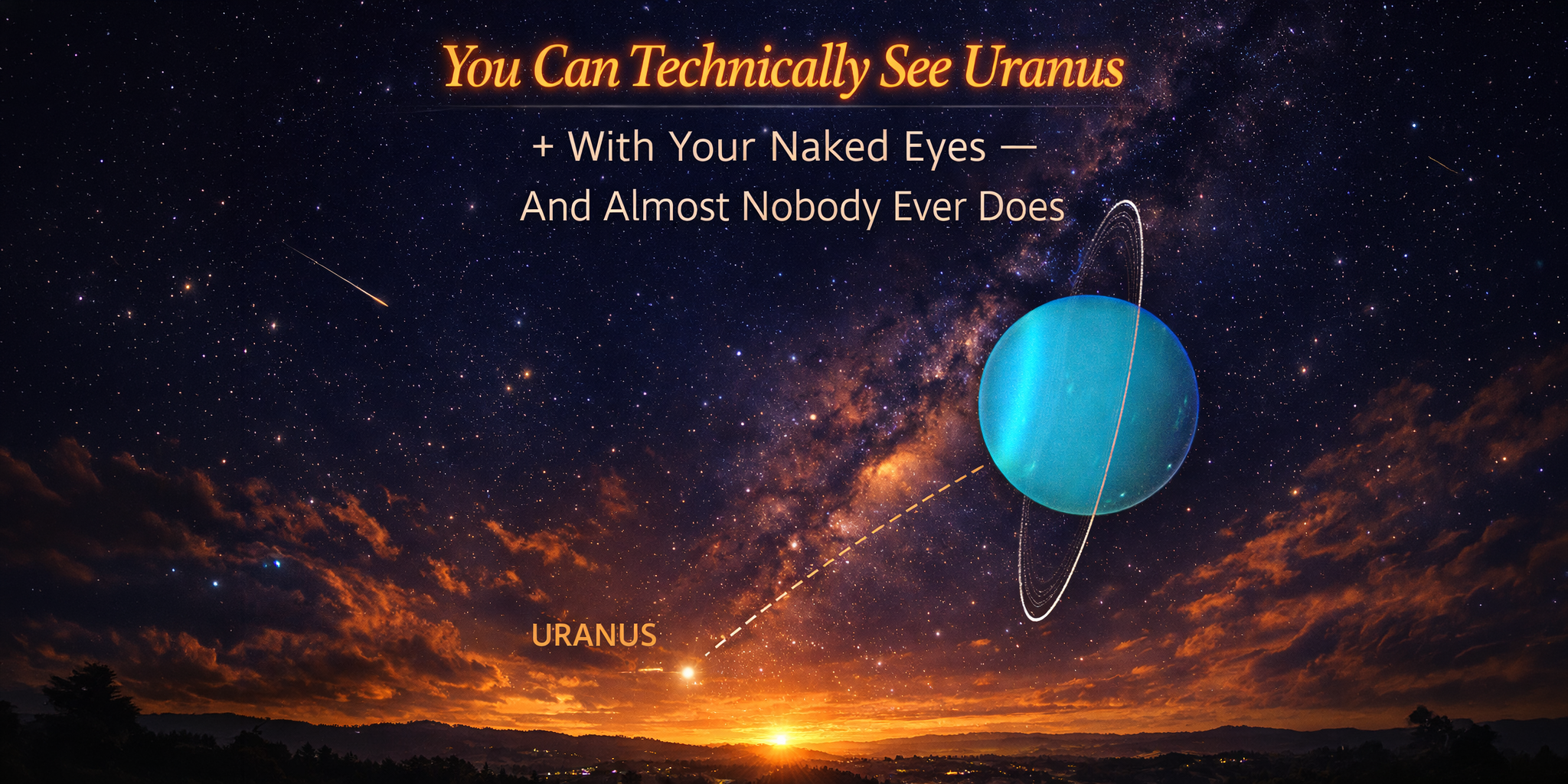
You Can Technically See Uranus With Your Naked Eyes — And Almost Nobody Ever Does

November 25, 2026 is your best chance to spot a planet that's 2.9 billion kilometers away. Without a telescope. Yes, really.

Here's a strange fact:

You might be able to see Uranus with your own eyes.

No telescope. No camera. No apps. Just you, your eyeballs, and 2.9 billion kilometers of empty space.

And yet, almost nobody ever does.

On November 25, 2026, Uranus reaches opposition — the point where it's closest to Earth, fully illuminated, and visible all night.

This is literally the best it gets.

And still... most people won't see it.

The Problem: Uranus Doesn't Want To Be Found

At around magnitude 5.6, Uranus is technically bright enough to be seen under very dark skies.

But "technically visible" and "actually noticeable" are two VERY different things.

Uranus doesn't stand out. It doesn't sparkle. It doesn't demand attention. It just... sits there. A tiny, faint point, almost indistinguishable from the surrounding stars.

This is the challenge.

To see Uranus, you need more than just eyesight. You need intention. You need to know exactly where to look. And you need to trust that what you're seeing is actually it.

Jupiter Finds You. Uranus Makes You Work For It.

Planets like Jupiter and Venus are attention seekers. They're bright. They're obvious. You spot them without trying.

Uranus doesn't do that.

You have to go find it. And when you do, the experience feels completely different.

Because suddenly, you're not just looking at the sky. You're SEARCHING it. You're comparing star brightness. You're noticing patterns. You're paying attention to details you would normally ignore.

And then, eventually, you see it.

Or at least, you THINK you do.

That moment — that uncertainty — is part of the experience.

Uranus doesn't confirm your observation. It doesn't announce itself. It just exists. Quietly. 2.9 billion kilometers away.

What You're Actually Looking At

A cold, distant world, tilted almost completely on its side — 98 degrees, basically rolling around the Sun like a barrel. It rotates in a way that makes it unlike any other planet in the solar system.

It has 27 known moons, named after characters from Shakespeare and Alexander Pope.

Its atmosphere is made of hydrogen, helium, and methane — which gives it that faint blue-green color you'd see in photos.

None of that is visible to your eyes.

What you see is a point. But what you understand is something much bigger.

You've crossed a threshold. You've gone from passively looking at the sky to actively engaging with it.

And that's rare. Because most of the time, we only notice what's easy.

Uranus isn't. And that's exactly why it matters.

Sources

NASA Solar System Exploration — https://solarsystem.nasa.gov

European Southern Observatory — https://www.eso.org/public/science/

ESA Science — https://www.esa.int/Science_Exploration