

28. July @ 11:30 am – 29. July @ 4:00 am CEST
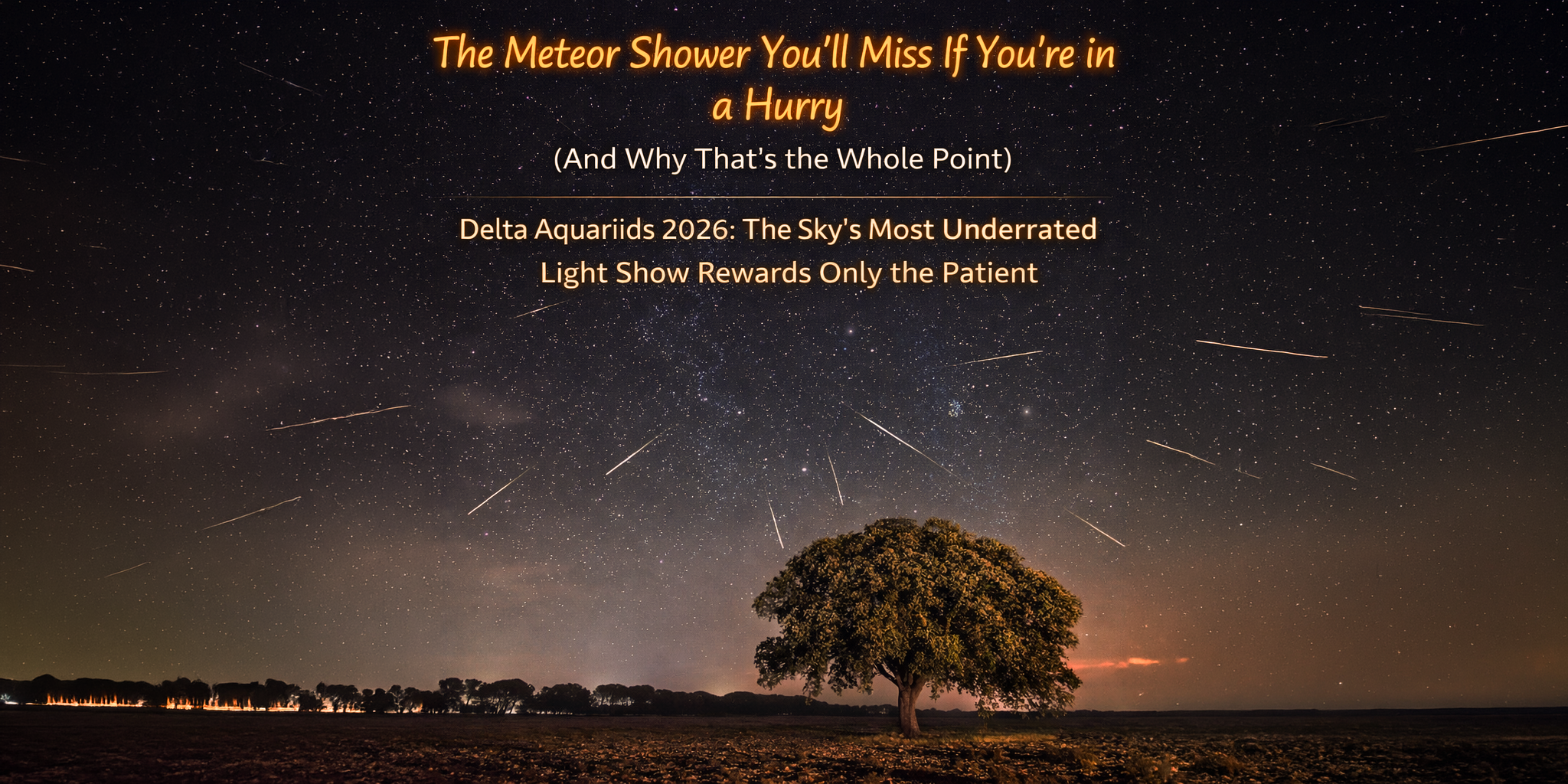
The Meteor Shower You'll Miss If You're in a Hurry (And Why That's the Whole Point)

Delta Aquariids 2026: The Sky's Most Underrated Light Show Rewards Only the Patient Not every meteor shower shows up screaming. Some arrive quietly. No intensity. No spectacle. No guarantee of fireworks. Just slow, subtle interruptions of darkness that only reveal themselves if you're willing to wait.

The Delta Aquariids are exactly that kind of shower.

They peak toward the end of July, when the nights are still short and the air often carries summer warmth long after sunset. It's not an obvious time for astronomy. The sky never fully reaches that deep, cold winter darkness.

And yet — if you stay long enough — something starts to happen.

What Makes This Shower Different

Unlike the Perseids or Geminids that dominate the sky, the Delta Aquariids are restrained. Under ideal conditions: maybe 20 meteors per hour. In practice? Long pauses. Intervals. Moments of stillness interrupted by brief flashes of motion.

And that's not a bug — it's the feature.

Because this shower isn't about quantity. It's about awareness. It forces you to look differently. Your eyes adjust. Your perception widens. You stop searching for something specific and start noticing the sky as a whole.

Then — flash. A short streak. Almost hesitant. And you realize: the sky isn't static. It's just slow.

Where These Meteors Come From

The Delta Aquariids are likely linked to Comet 96P/Machholz. Over time, this comet has scattered debris along its orbit — a stream of particles that Earth passes through every late July.

When those particles hit the atmosphere at high speeds, they compress the air in front of them, releasing energy as light. That's the meteor. That's the flash.

Scientifically, it's straightforward. But standing under the sky, it doesn't feel mechanical. It feels intermittent. Personal. Like the universe is showing you something one piece at a time.

How to Watch

Peak: Late July 2026

Best time: After midnight, when the radiant in Aquarius climbs higher. Find dark skies. Get comfortable. And wait.

The real value isn't in how many meteors you see.

It's in how they change the way you look at the sky.

Because they require patience. They require stillness. They require you to stay present long enough to notice something that doesn't happen constantly.

And in doing so, they reveal something fundamental: The universe is always in motion. It just doesn't always reveal that motion immediately.

Sometimes, it waits.

And sometimes, it rewards those who wait with it.


Sources

International Meteor Organization – https://www.imo.net

NASA Meteor Shower Guide – https://science.nasa.gov/meteors

ESA Science – https://www.esa.int/Science_Exploration