

12. August @ 2:00 pm – 5:00 pm UTC+0
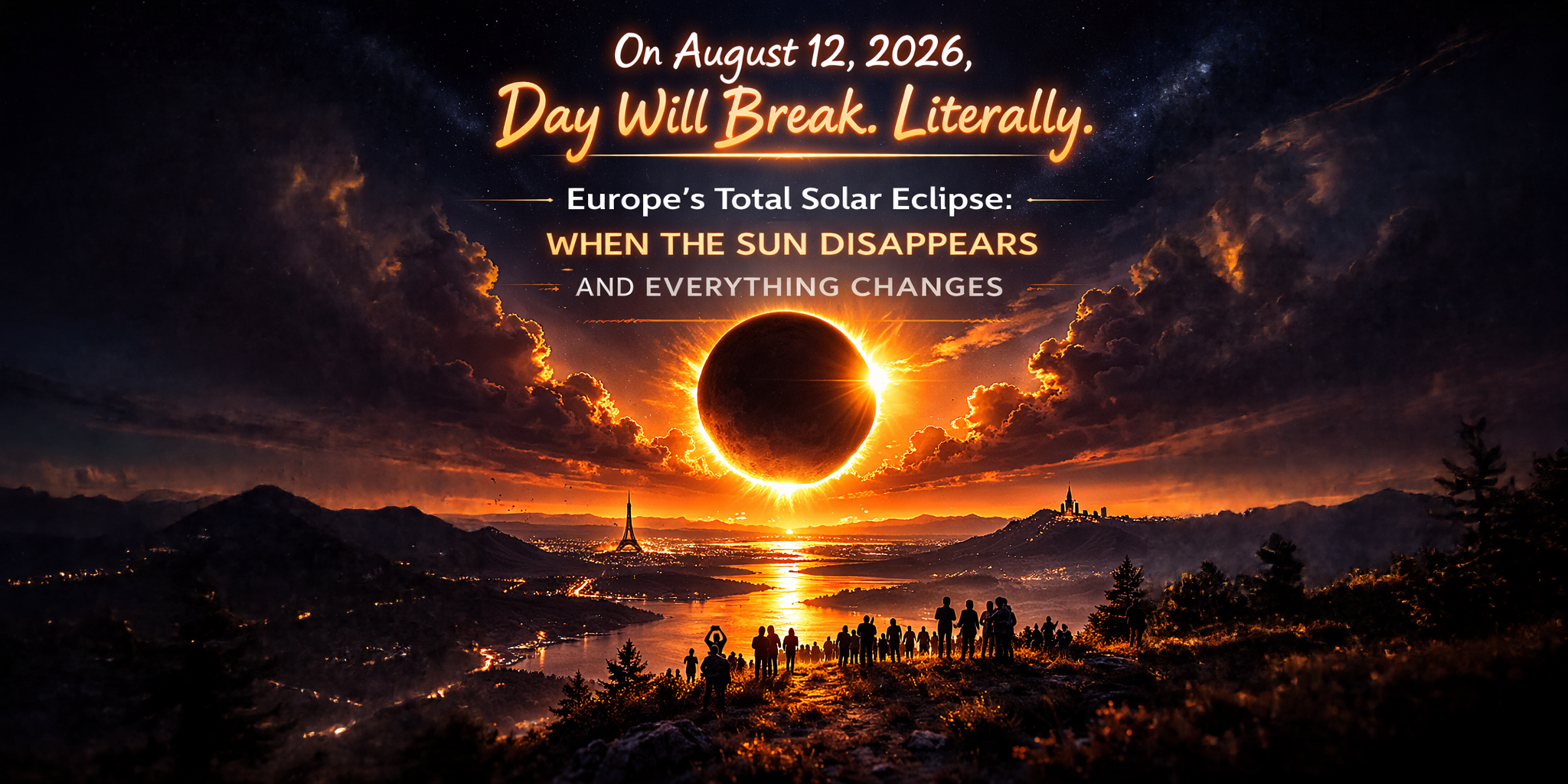
On August 12, 2026, Day Will Break. Literally.

Europe's Total Solar Eclipse: When the Sun Disappears and Everything Changes

The Sun rises. It crosses the sky. It sets. Day follows night. This rhythm feels so stable that it fades into the background of your life.

Until, for a few minutes, it doesn't.

On August 12, 2026, parts of Europe will experience something rare: a total solar eclipse. The Moon will pass directly between Earth and the Sun, blocking its light completely.

And when that happens, the world changes.

The Build-Up

At first, the shift is subtle. A small curve appears along the Sun's edge, as if something invisible is slowly cutting into it. The light remains bright, but something feels different. Shadows sharpen. Colors become colder, less vibrant.

Most people wouldn't notice it immediately. But if you're watching, you can feel it building.

The Moon continues its motion, covering more and more of the Sun. Daylight begins to dim — not like a sunset, but like something is being removed from the sky.

Because that's exactly what's happening.

The Science of the Cosmic Coincidence

The Moon is about 400 times smaller than the Sun. But it's also roughly 400 times closer. This coincidence — a quirk of orbital mechanics — allows the Moon to cover the solar disk almost exactly.

When the alignment is perfect, we get totality.

And totality is unlike anything else.

What Happens During Totality

The last sliver of sunlight disappears. And suddenly, it's night.

Not the gradual darkness of evening — an abrupt, almost disorienting transition. The sky darkens. Temperature drops. Birds fall silent or act as if dusk arrived hours early.

And where the Sun was, something entirely different appears.

The corona.

A faint, ethereal halo of light surrounding the Moon's dark silhouette. It's the Sun's outer atmosphere — normally invisible due to the overwhelming brightness of the solar surface.
During totality, it becomes visible. Soft. Structured. Extending outward in delicate streams shaped by the Sun's magnetic field.

This is what separates a total eclipse from a partial one. It's not just dimming. It's the revealing of something that's usually hidden.

Then It Ends

Totality lasts only minutes — in some locations, less than two. Then a point of light appears along the Moon's edge. The first beam of sunlight returns. The sky brightens quickly, almost aggressively.

Daylight reasserts itself. The world returns to normal.

But the memory stays.

Because a solar eclipse isn't just an astronomical event. It's a disruption of expectation. It reminds you that the systems you rely on — light, time, rhythm — aren't fixed. They're the result of motion, alignment, and coincidence.

And for a few minutes, all of that becomes visible.


Sources

NASA Eclipse Page – https://eclipse.gsfc.nasa.gov

ESA Science – https://www.esa.int/Science_Exploration

ESO – https://www.eso.org/public/science/