

17. October @ 11:00 pm – 19. October @ 3:00 pm CEST
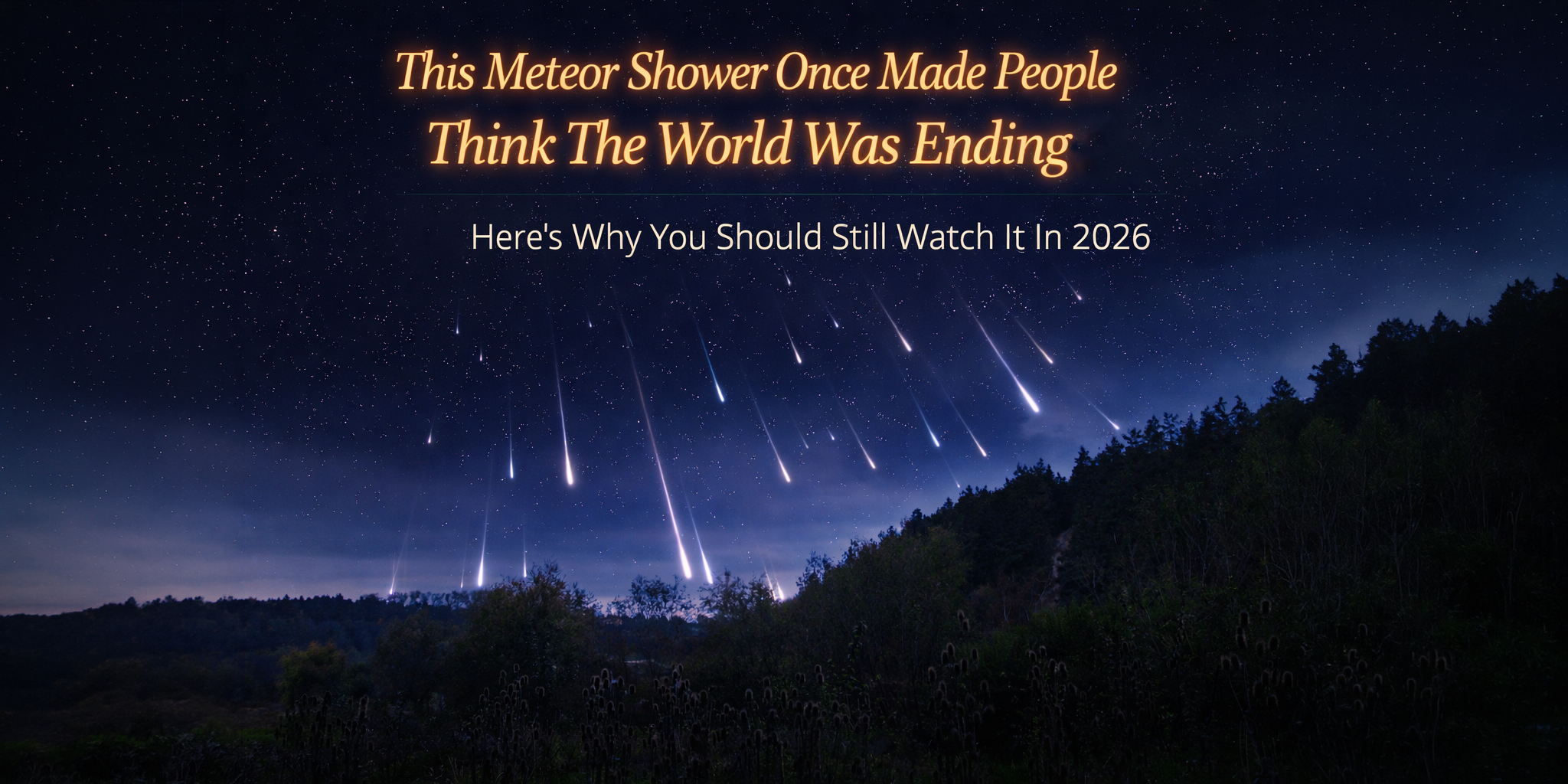
This Meteor Shower Once Made People Think The World Was Ending — Here's Why You Should Still Watch It In 2026

The Leonids have a REPUTATION. 2026 might be chill, but the physics that caused the 1833 sky apocalypse is still very much there.

Let's talk about reputation.

The Leonids don't have one because of what they usually do. They have one because of what they've DONE.

And what they've done is absolutely unhinged.

In 1833, observers across North America described the sky as 'falling.' Meteors appeared so frequently that they felt continuous — like rain, but made of light. People genuinely thought the world was ending. Thousands of meteors per hour. THOUSANDS.

That's the Leonids.

Now, 2026? Around 15 meteors per hour. Not exactly apocalyptic.

But here's why you should still care.

The Physics Is Still The Same

The Leonids come from Comet Tempel-Tuttle, which orbits the Sun every 33 years. As it moves, it leaves behind dense streams of debris.

Most years, Earth passes through the outer edges of those streams. Result: a modest meteor shower.

But when Earth intersects a denser filament? That's when meteor STORMS happen. That's what caused 1833. That's what could happen again.

2026 is not one of those years. But the system that creates them is still there.

Every meteor you see is a fragment of that comet. Every streak is part of a much larger system.

These Are The FASTEST Meteors You'll Ever See

Here's what makes Leonids different even in a 'quiet' year:

They enter Earth's atmosphere at 71 kilometers per second.

That's among the highest velocities of ANY meteor shower. For comparison, the Draconids hit at about 20 km/s.

And that speed changes everything. Leonids produce long, thin streaks. Often with persistent trains — glowing trails that remain visible for SECONDS after the meteor itself has disappeared.

It's not about quantity. It's about quality.

2026 Conditions Are Actually Pretty Good

The Moon sets after midnight, leaving a window of dark sky during the early morning hours — exactly when the Leonid radiant (in the constellation Leo) rises higher.

Best viewing: Pre-dawn. When Earth is rotating directly into the stream of particles.

Expected rate: Around 15 per hour under good conditions.

But here's the thing about expectations: once you know the history — once you understand what this meteor shower is CAPABLE of — every meteor feels like part of something bigger.

Not just a random streak.

A fragment of a comet that once made humanity think the sky was breaking.

That's why people still go out to watch. Not because they expect a storm. But because they know it's possible.

And possibility is sometimes enough.

Sources

NASA Meteor Showers — https://science.nasa.gov/meteors

International Meteor Organization — https://www.imo.net

American Meteor Society — https://www.amsmeteors.org