

21. October @ 11:00 pm – 22. October @ 3:30 pm CEST
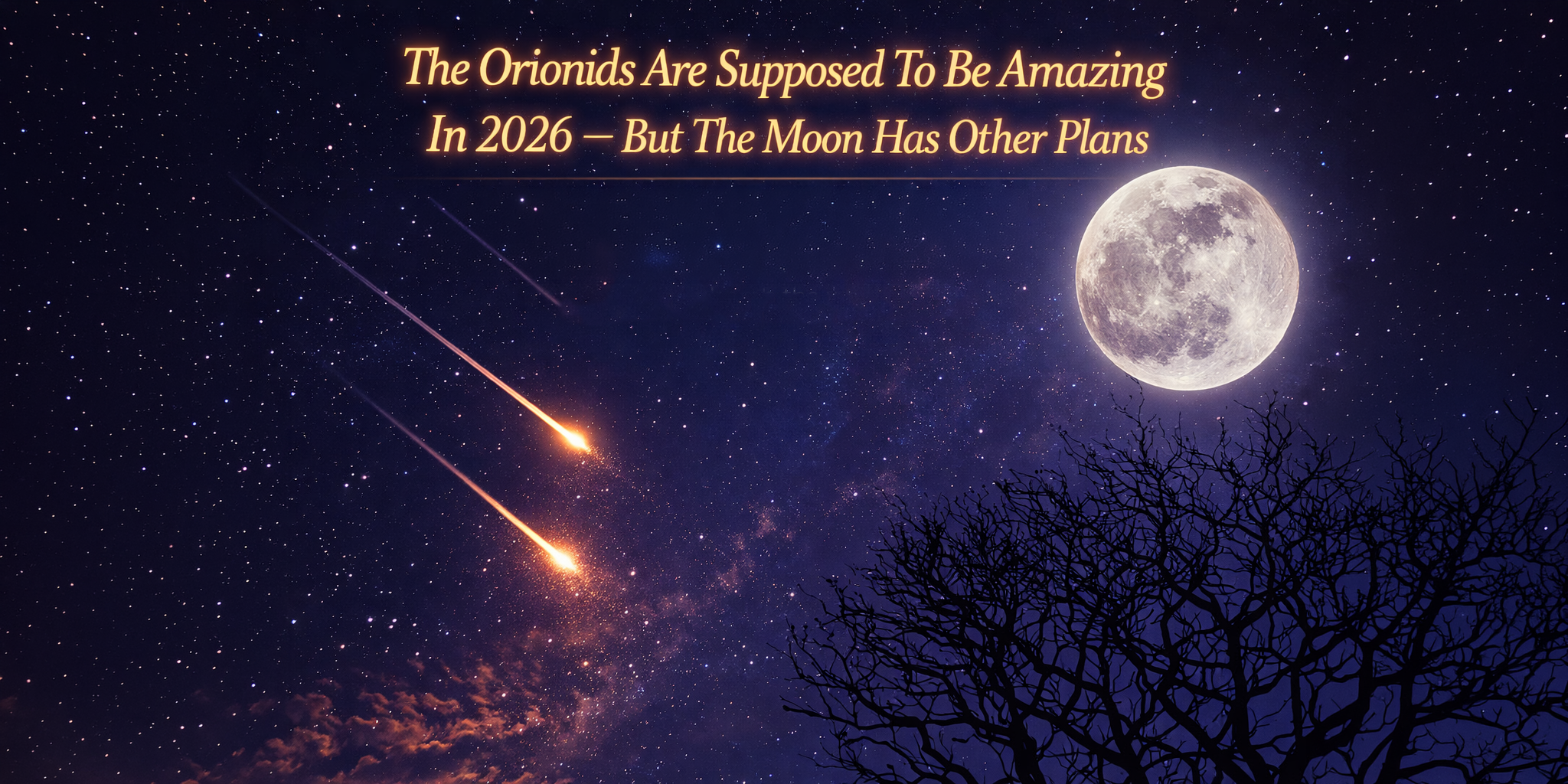
The Orionids Are Supposed To Be Amazing In 2026 — But The Moon Has Other Plans

Halley's Comet debris, 66 km/s entry speeds, gorgeous trails. Too bad a nearly full Moon is about to photobomb the whole thing.

Let's start with what SHOULD happen.

The Orionids are objectively good. Around 15 meteors per hour. Fast streaks. Long, glowing trails. A direct connection to Halley's Comet — arguably the most famous comet in human history.

On paper, this should be a top-tier meteor shower.

But 2026 doesn't care about paper.

Because this year, the Orionids run straight into a problem: a bright Moon, close to full, sitting exactly where you don't want it. Flooding the sky with light. Washing out the faint meteors. Turning what should be a dark canvas into something much harder to read.

The physics is unchanged. The debris is there. The particles are slamming into Earth's atmosphere at 66 kilometers per second — fast enough to ionize air and produce brilliant trails.

What you experience on the ground? That's different.

The Halley's Comet Connection Is Legitimately Cool

Real talk: watching the Orionids means you're watching debris from Halley's Comet.

The same comet that swings through the inner solar system every 76 years. The same comet that's been documented since 240 BCE. The same comet that Mark Twain was famously born under (and died under, 76 years later).

As Halley's Comet travels, it sheds particles that spread along its orbit. Every October, Earth passes through that stream. The particles burn up in our atmosphere. And that's what you see.

Ancient comet dust. Incinerated at 66 km/s. Above your head.

That's genuinely incredible — even when the Moon is ruining the view.

Why Moonlight Matters More Than You Think

Here's the thing about meteor showers: they're not all equally bright.

Most meteors are faint. They're small particles, making brief streaks. Under dark skies, you see all of them — the faint ones, the bright ones, the occasional fireball.

Add a bright Moon, and the faint ones disappear. The contrast drops. The sky doesn't go fully dark. Only the brightest streaks — the ones that can compete with the glow — remain visible.

So instead of a steady 15 per hour, you might see... 5. Maybe 7.

But here's the flip side:

Every meteor you DO see had to fight through that brightness. And when it does, it stands out more. It feels stronger. More intentional.

There's something almost cinematic about it — a bright streak cutting through a sky that refuses to go fully dark.

How To Actually Watch This Thing

The radiant (where the meteors appear to come from) is near the constellation Orion — which rises after midnight and climbs higher toward morning.

Best viewing: Pre-dawn hours. Position yourself so the Moon is behind a building or tree. Look toward the darkest part of your sky.

Expectations: Don't go out expecting perfection. Go out expecting conditions. Light. Contrast. Timing.

Because astronomy isn't passive. It's contextual.

And that context matters.

If you understand the limitations — the Moon, the brightness, the reduced visibility — you start to see something else. Not a perfect meteor shower. But a real one.

One shaped by conditions. One that reminds you that the sky is not just what's happening out there.

It's what reaches you.

Sources

NASA Meteor Showers — https://science.nasa.gov/meteors

International Meteor Organization — https://www.imo.net

ESA Science — https://www.esa.int/Science_Exploration