

21. June @ 11:00 am – 3:00 pm CEST
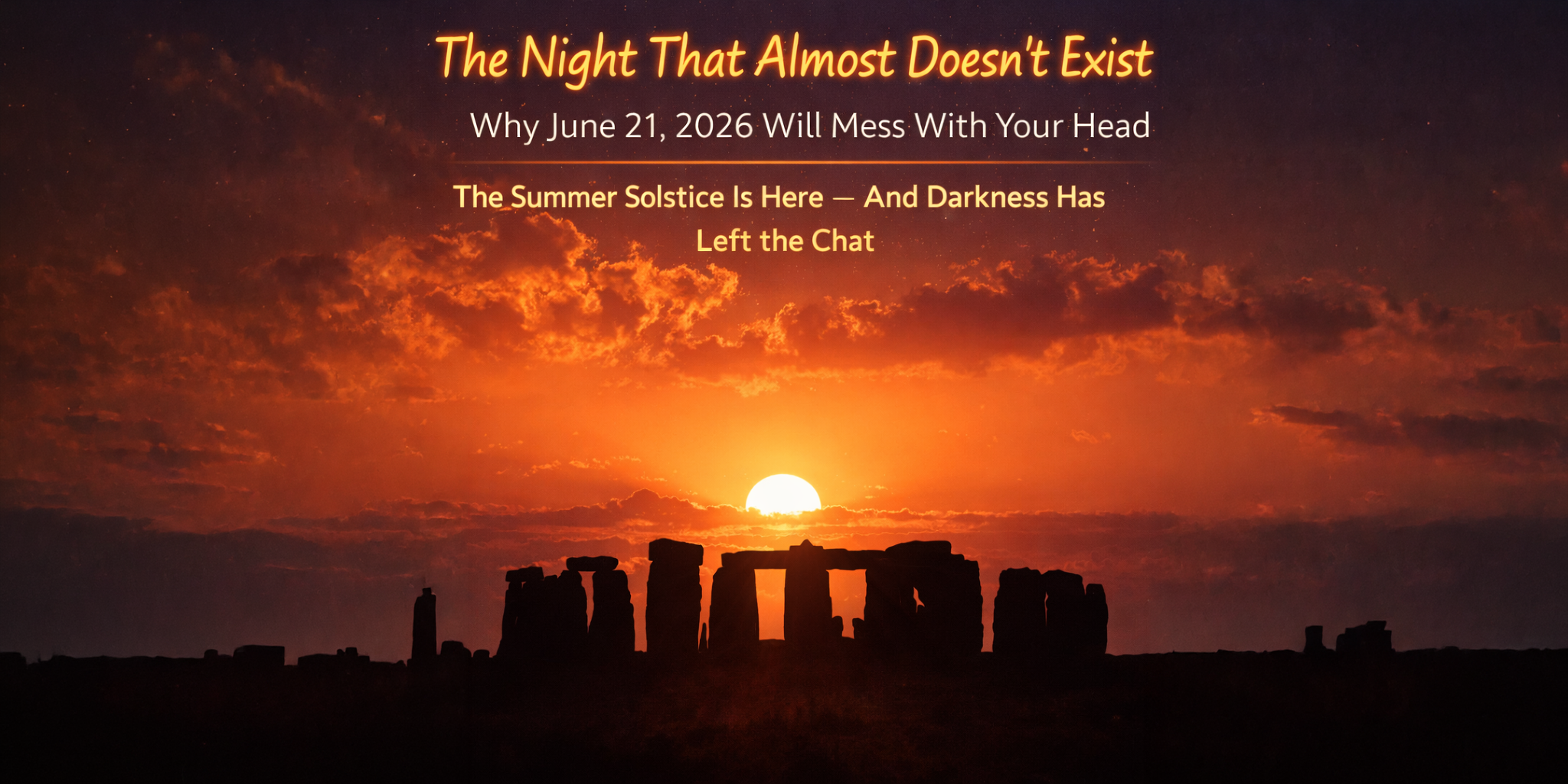
The Night That Almost Doesn't Exist: Why June 21, 2026 Will Mess With Your Head

The Summer Solstice Is Here — And Darkness Has Left the Chat

There's a night coming when darkness basically gives up.

You won't notice it all at once. It creeps in over weeks — evenings that stretch a little longer, skies that hold onto light a little more stubbornly. And then one night, you step outside after sunset and realize: the darkness never fully arrives.

Welcome to June 21, 2026. The summer solstice. The longest day of the year.

And the night that almost disappears.

Here's What's Actually Happening

Earth is tilted. About 23.5 degrees off vertical. This isn't dramatic enough to notice day-to-day, but it's dramatic enough to create seasons.

At the summer solstice, the Northern Hemisphere reaches maximum tilt toward the Sun. The Sun climbs higher in the sky than at any other time of year. It rises early. Sets late. Spends more time above the horizon than on any other day.

But here's the trippy part: even after sunset, the Sun doesn't actually leave.

It sinks below the horizon at a shallow angle. So shallow that its light keeps interacting with the atmosphere long after it's no longer visible. Twilight stretches. Civil twilight blends into nautical twilight, which blends into astronomical twilight.

And in some locations? Full darkness never arrives at all.

What It Actually Looks Like

The sky stays suspended. Not day. Not night. Something in between.

Stars appear late, almost hesitant. Only the brightest ones break through the lingering glow. The faint ones — the ones that usually fill the sky — stay hidden. The Milky Way, that defining feature of a truly dark sky, barely makes an appearance.

For astronomers, this is the most challenging time of year. The window of darkness shrinks to a few hours, sometimes less. Deep-sky objects become hard to see — not because they're gone, but because the sky itself never fully clears of sunlight.

But Here's Why It's Actually Beautiful

The solstice isn't a loss. It's a peak.

A turning point.

Because after this day, the motion reverses. Almost imperceptibly at first, the Sun begins to lower its path. Days start to shorten. Nights begin to return.

Standing outside on the evening of June 21, you're witnessing a precise moment in a continuous cycle. The Earth is still moving. Still orbiting. Still tilted. And this exact orientation of planet and star happens only once each year.

It's not an event you watch.

It's a condition you exist inside.

And somewhere beyond that lingering twilight glow, the stars are still there. Waiting for darkness to return.


Sources

NASA Earth Observatory – https://earthobservatory.nasa.gov

European Southern Observatory – https://www.eso.org/public/science/

Britannica – Solstice – https://www.britannica.com/science/solstice