NASA Just Sent A Crew Around The Moon For The First Time In 50 Years. A Permanent Base Is Next. Here’s What Could Actually Kill You There.
In April 2026, four astronauts flew around the Moon and came back. It was the first crewed mission beyond low Earth orbit since 1972.
Artemis II broke the record for the farthest distance humans have ever traveled from Earth: 406,773 kilometers. Reid Wiseman, Victor Glover, Christina Koch, and Jeremy Hansen looked out their window and saw the far side of the Moon with their own eyes, not through a probe’s camera.
And here’s the part most people missed: this is just the warm-up.
NASA is planning to land astronauts on the Moon’s south pole in 2028 with Artemis IV. They want to build a permanent base. They want to stay. They’ve presented a $20 billion plan to make it happen.
So the question is no longer ‘can we go to the Moon?’ — that part is settled. The real question is: can humans actually live there? And the honest answer is more complicated than the hype suggests.
The Moon Is Not A Friendly Place
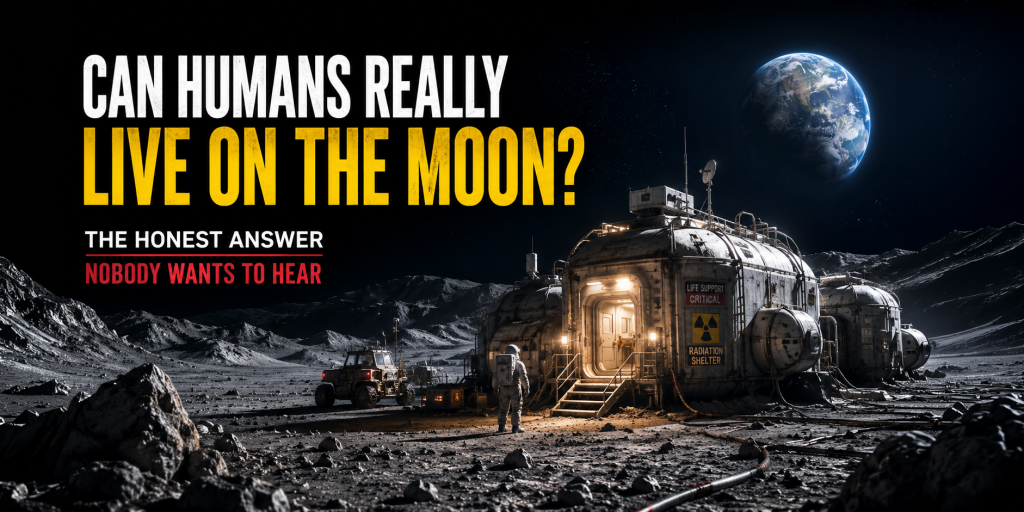
Let’s get one thing straight: the Moon is not Mars-lite. It’s not a cute, dusty backyard. It is one of the most hostile environments humans have ever attempted to inhabit.
It has no atmosphere. None. The air pressure on the lunar surface is essentially zero. Step outside without a suit and you have about 15 seconds before you lose consciousness. Your blood doesn’t boil dramatically like in movies, but the moisture on your eyes and tongue does begin to evaporate. Decompression injuries follow. Death within minutes.
Temperatures swing from about +127 degrees Celsius in direct sunlight to -173 degrees Celsius in shadow. There’s no atmosphere to moderate the difference, no weather to even things out. Step from sun to shade and you’ve crossed a temperature gap of 300 degrees.
And the lunar night lasts 14 Earth days. Two weeks of continuous darkness, with temperatures plunging far below anything on Earth. Whatever you build there has to survive this. Twice a month. Forever.
Radiation: The Invisible Killer
Earth protects us from cosmic radiation with two layers of defense: a thick atmosphere and a strong magnetic field. The Moon has neither.
On the lunar surface, astronauts would be exposed to a constant bombardment of solar radiation, cosmic rays, and energetic particles. The radiation dose on the Moon is roughly 200 times higher than on Earth’s surface. Even short stays accumulate exposure quickly.
And then there are solar storms. When the Sun ejects a major coronal mass ejection, a stream of charged particles can hit the lunar surface with enough energy to be fatal. Earth’s magnetic field deflects most of this. Moon residents would have minutes to take shelter underground.
Long-term radiation exposure on the Moon leads to significantly elevated cancer risk, cognitive decline, and tissue damage. Any permanent base will need substantial radiation shielding — likely meters of lunar regolith piled over habitats, or burial in natural lava tubes.
Lunar Dust: The Enemy You Don’t See Coming
Of all the problems the Moon presents, the one that surprises people most is the dust.
Lunar regolith — the loose surface material — is unlike anything on Earth. There’s no wind or water to weather the particles smooth. Every grain is sharp, jagged, glass-like. Imagine microscopic shards of broken glass coating everything you touch.
It’s also electrostatically charged. Lunar dust clings to surfaces with surprising force. Apollo astronauts found it stuck to their suits no matter how hard they tried to clean it. It got tracked into the lunar module. It clogged seals, abraded equipment, and ground its way into mechanisms.
Apollo astronaut Harrison Schmitt reported ‘lunar hay fever’ from inhaling the dust inside the lunar module — sneezing fits, watery eyes, and a sore throat. The long-term health effects of breathing this stuff are unknown, but the short-term effects suggest something between asbestos and ground glass.
A permanent base will need to solve the dust problem. Airlocks that don’t track it inside. Suits that can be cleaned. Filtration systems that can handle sharp, charged particles. Nobody has fully cracked this yet.
Your Body Was Not Designed For This
Even if you solve all the environmental problems, there’s one you can’t engineer your way out of: the human body.
The Moon’s gravity is about one-sixth of Earth’s. Your body, which evolved over millions of years to function in 1g, doesn’t handle this well. Bone density decreases. Muscles atrophy. Cardiovascular systems weaken. Fluid distribution shifts and causes vision problems — astronauts on the ISS regularly experience deteriorating eyesight, and that’s after just months in microgravity.
Decades of ISS research show that without serious exercise and countermeasures, astronauts lose about 1-2% of their bone mass per month in microgravity. The Moon is better than zero gravity but worse than Earth. We don’t yet know exactly how much bone and muscle deterioration occurs at 1/6 g over long periods.
Children born on the Moon would face an even bigger problem. Their bodies would develop adapted to lunar gravity. Returning to Earth might be impossible — their bones would shatter under their own weight.
If humans ever truly live on the Moon, the first lunar-born generation may never come home.
Why The South Pole?
NASA isn’t planning to build a base just anywhere on the Moon. The target is the south polar region. There’s a reason.
The lunar south pole has something extremely valuable: water.
Deep craters near the south pole are in permanent shadow. They’ve never seen sunlight, possibly for billions of years. Inside these shadowed regions, temperatures stay below -200 degrees Celsius, cold enough that water ice deposited by ancient comet impacts has remained frozen, untouched.
Water means everything for a lunar base. Drinking water. Oxygen (split water with electrolysis). Hydrogen for rocket fuel. Radiation shielding. Plant growth. Almost every survival problem on the Moon has ‘extract water from the regolith’ as part of the solution.
And the rim of these polar craters gets nearly continuous sunlight, perfect for solar power. The combination — shadow craters for water, sunlit ridges for power — is the closest thing the Moon offers to a viable base location.
Lava Tubes: The Best Real Estate On The Moon
Forget surface domes. The smart bet for a permanent lunar base is underground.
The Moon is riddled with lava tubes — empty tunnels left behind from when lava flowed across the surface billions of years ago. Some of these tubes are enormous. Several discovered so far are over 50 meters wide and hundreds of meters long.
Lava tubes solve multiple problems at once. Their thick rock walls block radiation. The temperature inside is stable, regardless of the surface day-night swings. They protect against micrometeorite impacts. They could potentially hold pressurized habitats much larger than anything that could be built on the surface.
If we ever build a permanent lunar base, it probably won’t look like the Apollo-era surface habitats people imagine. It’ll be cities inside caves. Underground colonies. The Moon, but underground.
The Realistic Timeline
Here’s where the hype meets reality.
Artemis IV is currently planned for 2028. That’s the mission that will actually put humans back on the lunar surface for the first time since Apollo 17 in 1972.
Artemis V follows in late 2028, expected to begin the work of building a permanent base. After that, NASA plans roughly annual lunar landings, each one adding capability and infrastructure.
But here’s the catch: ‘building a permanent base’ doesn’t mean ‘people will live there permanently.’ Early lunar bases will be like Antarctic research stations — small crews rotating in and out, conducting research, gradually expanding infrastructure. Not colonies. Not families. Not permanent residents.
Actual long-term human habitation, where people spend years or decades on the Moon, is probably 2040s or later. And true self-sustaining lunar settlements, where humans live without constant resupply from Earth? That’s probably still 50-100 years away, if it ever happens at all.
The Cost Of Living There
NASA’s plan to build a permanent lunar presence has been priced at around $20 billion just to get started. The annual operating costs of an ongoing lunar program will be massive — every piece of equipment, every gram of food, every breath of air will eventually trace back to a rocket launched from Earth.
Getting one kilogram of material to the Moon’s surface currently costs roughly hundreds of thousands of dollars. The reusable Starship system promises to bring this down — possibly dramatically — but it’s still expensive. Building a sustainable base means either using local materials or accepting that everything costs more than gold.
ISRU — in-situ resource utilization — is the technical term for using what’s already on the Moon. Extracting water from shadowed craters. Making oxygen from regolith. 3D-printing habitats from lunar dust. These technologies exist in prototype form. None of them are operationally ready at scale.
So Can We Actually Live There?
Yes. Technically. With enough money, enough engineering, enough political will, humans can live on the Moon.
But ‘can live there’ is different from ‘will want to live there.’ Life on the Moon means living underground or in heavily shielded habitats. It means never going outside without a suit. It means accepting elevated cancer risk, bone loss, vision problems, and psychological isolation. It means being completely dependent on resupply from Earth for decades, possibly centuries.
It’s not impossible. But it’s also not a vacation destination. The first lunar residents won’t be settlers. They’ll be researchers. Workers. Specialists. People with specific reasons to be there and the skills to survive.
The Moon won’t become a second Earth in our lifetimes. But it might become humanity’s first foothold beyond our home planet. The place where we learn how to live somewhere other than Earth.
And from there, everywhere else gets a little closer.
Sources
NASA Artemis Program – https://www.nasa.gov/humans-in-space/artemis/
NASA Artemis II Mission – https://www.nasa.gov/mission/artemis-ii/
Apollo Mission Reports – Lunar Dust Health Effects
ESA Lunar Exploration – https://www.esa.int/Science_Exploration/Human_and_Robotic_Exploration/Moon
ISS Research – Long-Duration Spaceflight Health Effects