The Dirty Secret of Amateur Astronomy: Aperture Fever Is Real, and It’s Expensive
Let’s get one thing out of the way: yes, bigger telescopes can see more.
More light. More detail. More faint, distant objects pulled from the cosmic void into your eyepiece.
That’s physics. That’s true. And that’s exactly why so many beginners walk into their first telescope purchase thinking bigger = better, only to end up with an expensive dust collector sitting in the garage six months later.
The telescope industry has a name for this phenomenon: aperture fever.
And it’s one of the biggest reasons people abandon astronomy before they ever really start.
The Physics of Light (And Why It’s Not the Whole Story)
First, the basics. A telescope’s aperture — the diameter of its primary mirror or lens — determines how much light it can collect. Double the aperture, and you collect four times as much light (because area scales with the square of the diameter).
More light means you can see fainter objects. Distant galaxies. Faint nebulae. The dim moons of distant planets.
Aperture also affects resolution — the ability to see fine detail. A larger aperture can theoretically resolve finer features on planetary surfaces, split closer double stars, and reveal more structure in deep-sky objects.
So far, so obvious. Bigger is better, right?
Not so fast.
Because physics doesn’t exist in a vacuum. And neither does your telescope.
Problem #1: The Atmosphere Doesn’t Care About Your Aperture
Here’s something telescope advertisements won’t tell you: on most nights, atmospheric turbulence — what astronomers call “seeing” — limits what you can actually resolve to far less than what your optics are capable of.
The atmosphere is constantly moving. Cells of air at different temperatures create turbulence that distorts the light passing through. It’s the same effect that makes stars twinkle — except twinkling is the enemy of detailed observation.
On an average night, the atmosphere limits resolution to what a 100-150mm (4-6 inch) telescope can deliver. Your 300mm monster scope? It’s collecting more light, sure. But it’s not showing you more detail — the air won’t let it.
Professional observatories solve this with adaptive optics — deformable mirrors that adjust hundreds of times per second to counteract atmospheric distortion. Your backyard Dobsonian does not have this.
The result? On many nights, a smaller, well-made telescope will show you planetary detail just as sharp as a much larger one. The bigger scope is just fighting harder against the same atmospheric limits.
Problem #2: Thermal Equilibrium Is a Real Thing
Large mirrors take time to cool down.
When you bring a telescope outside from a warm house or garage, the mirror is warmer than the surrounding air. As it radiates heat, it creates air currents inside the telescope tube — currents that distort the image.
A small 4-inch refractor might reach thermal equilibrium in 15-20 minutes. A 12-inch Dobsonian with a thick glass mirror? You’re looking at 1-2 hours. Some large instruments need even longer.
That’s 1-2 hours of waiting before the scope is performing at its best. If you only have a couple of hours to observe on a weeknight, half your session might be gone before the views actually get good.
Smaller scopes are ready faster. They adapt quicker. They let you actually use your limited observing time.
Problem #3: The Best Telescope Is the One You Actually Use
This is the big one. The one that experienced astronomers repeat like a mantra. The one that beginners ignore at their peril.
A telescope that stays in the closet shows you nothing.
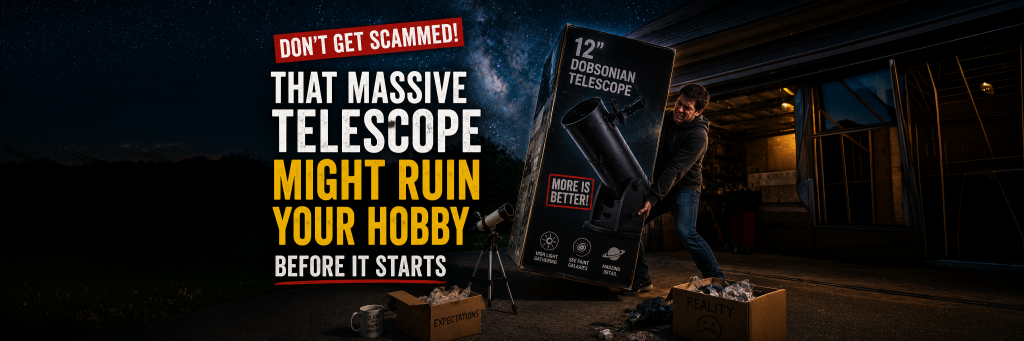
That 12-inch Dobsonian might have phenomenal light-gathering power. But it also weighs 30+ kilograms. It takes two trips to carry outside. It requires setup and alignment. By the time you’ve got it ready, your motivation might be gone.
A compact 5-inch scope that you can grab with one hand and have observing in 2 minutes? You’ll use it on a whim. You’ll take it out “just for a quick look” and end up spending an hour under the stars.
Frequency of use matters more than aperture for most hobbyists. Someone who observes 50 nights a year with a modest telescope will see more, learn more, and enjoy more than someone who drags out a behemoth twice a year.
Problem #4: Portability Changes Everything
If you live in a city — and statistically, you probably do — your backyard sky is compromised. Light pollution washes out faint objects regardless of your telescope’s aperture.
The solution? Drive somewhere darker.
But here’s the catch: a telescope that doesn’t fit in your car doesn’t go anywhere. A telescope that requires 45 minutes of disassembly and reassembly makes every trip feel like a commitment.
Smaller scopes are portable. They fit in trunks. They set up in minutes at a dark site. They let you escape light pollution instead of fighting it with brute-force aperture.
A 6-inch scope under truly dark skies will often show you more than a 10-inch scope in a light-polluted suburb. Location beats aperture.
Problem #5: Mount Requirements Scale Dramatically
Bigger telescopes need bigger mounts. This isn’t optional — it’s physics.
A shaky mount amplifies every vibration. Touch the focuser, and the image wobbles for seconds. Wind catches the tube, and planets dance. High magnifications become exercises in frustration.
A properly stable mount for a large telescope often costs more than the telescope itself. It’s heavier, bulkier, and slower to set up.
Meanwhile, a smaller telescope on a modest but adequate mount stays rock-steady. The viewing experience is actually better because the image is stable.
Problem #6: What Are You Actually Observing?
Here’s a question most beginners don’t ask: what do you actually want to look at?
The Moon. Planets. Bright star clusters. Double stars. The Orion Nebula. These are the objects that hook people on astronomy. And they all look great in modest apertures.
A 4-inch refractor will show you Saturn’s rings, Jupiter’s cloud bands and moons, lunar craters sharp enough to make you gasp, and dozens of beautiful double stars. A 6-inch reflector opens up bright galaxies, nebulae, and globular clusters.
The objects that truly require massive aperture — faint galaxy groups, planetary nebula details, dim outer-solar-system bodies — are advanced targets. Most beginners never get there. And if they do, they can upgrade later.
Starting with a scope you’ll actually use, learning the sky, developing skills — that’s what matters. Aperture can come later.
The Real Advice Nobody Wants to Hear
The best first telescope is often a modest one.
Something in the 4-6 inch range for reflectors, or 3-4 inches for refractors. Something you can carry with one hand. Something that’s ready to observe in minutes. Something that doesn’t require a perfect night or an hour of cool-down time.
If you fall in love with the hobby — if you find yourself outside every clear night, learning constellations, hunting deep-sky objects, understanding what makes a great observing session — then upgrade. By then, you’ll know exactly what you want.
But if you start with a behemoth that lives in the garage because it’s too much hassle to set up? You’ll never get there.
Aperture fever is real. But the cure isn’t a bigger scope.
It’s a scope you’ll actually use.
Sources
Sky & Telescope – Choosing Your First Telescope – https://skyandtelescope.org
Cloudy Nights – Telescope Reviews and Community – https://www.cloudynights.com
European Southern Observatory – Atmospheric Seeing – https://www.eso.org
NASA Night Sky Network – https://nightsky.jpl.nasa.gov