Our Galaxy Is Spinning, Swallowing Smaller Galaxies, And Hiding A Monster At Its Center. And You’re Riding Along.
Here’s something most people don’t think about: you’ve never seen our galaxy from the outside.
Every photo you’ve ever seen of ‘the Milky Way’ is either taken from inside it (the band of stars across the night sky) or is an artist’s illustration based on what we’ve deduced. We’ve never had a probe far enough away to look back and see it.
And yet, we know what it looks like. We know its size, its shape, its mass, the number of arms it has. We know what’s at its center. We know how fast it’s spinning and where it’s headed.
How? Because we’re inside it. And we’ve gotten very good at figuring out what something looks like from the inside out.
This is what we know about the galaxy you live in.
The Basic Stats Are Absurd
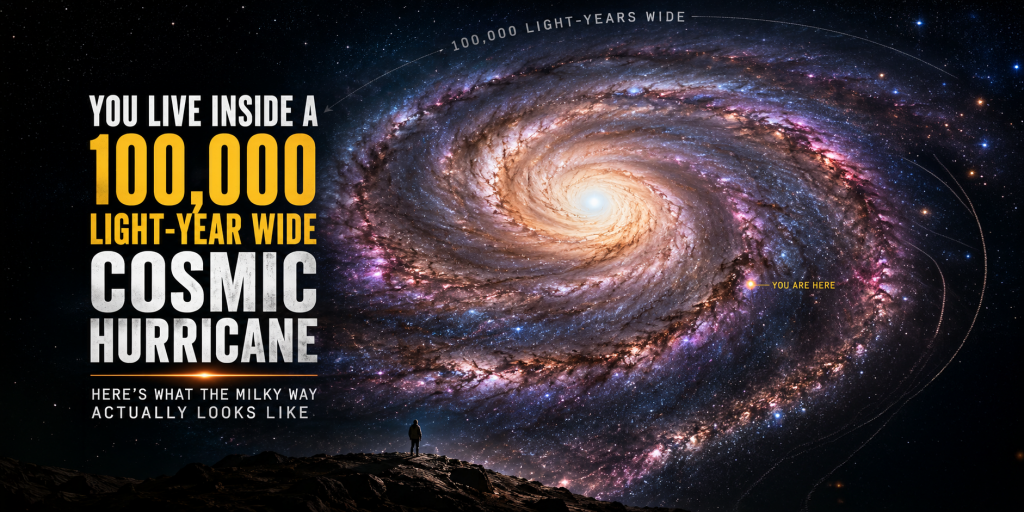
The Milky Way is a barred spiral galaxy roughly 100,000 light-years across.
Light, which travels 300,000 kilometers every second, takes 100,000 years to cross it. If you sent a radio signal from one edge to the other, the great-great-grandchildren of whoever sent it would die before it arrived.
It contains somewhere between 100 billion and 400 billion stars. Astronomers can’t pin down the exact number because most of those stars are too faint or hidden behind dust clouds to count directly. We estimate by mass, by motion, by what the gravity tells us must be there.
Total mass: approximately 1.5 trillion times the mass of our Sun. Most of that — at least 80% — is dark matter. The actual stars, gas, dust, and planets account for a minority of what’s in there.
Welcome to your home.
The Shape: It’s Not Just a Spiral
For decades, textbooks showed the Milky Way as a perfect pinwheel spiral. That picture is outdated.
In 2005, observations with the Spitzer Space Telescope confirmed that the Milky Way is a barred spiral — meaning the central region isn’t a simple sphere. It’s an elongated bar of stars roughly 27,000 light-years long, running through the middle of the galaxy.
From that bar, the spiral arms extend outward. We currently believe there are two major arms (Scutum-Centaurus and Perseus) and two minor arms (Sagittarius and Norma), plus a smaller spur called the Local Arm or Orion Spur.
We live in the Orion Spur. Not even in one of the main arms — just a smaller appendage between them. Cosmic suburbs.
The whole disk is thin compared to its width. About 1,000 light-years thick in the disk, surrounded by a thicker halo of older stars extending out to about 100,000 light-years in radius.
Where We Are: Definitely Not the Center
Our Sun sits approximately 26,000 light-years from the galactic center. That puts us about two-thirds of the way out from the middle.
This is, statistically, a pretty average location. Not in the dense, chaotic center where stellar collisions and radiation would make planetary life nearly impossible. Not out in the sparse outer reaches where there aren’t enough heavy elements to build rocky planets. Somewhere in the middle, where things are stable, planets can form, and life has had billions of years to evolve.
This region — between roughly 7 and 9 kiloparsecs from the center — is sometimes called the galactic habitable zone. We’re inside it. Which is convenient.
Sagittarius A*: The Monster At The Center
At the very center of the Milky Way is a supermassive black hole called Sagittarius A* (pronounced ‘A-star’).
It has a mass of approximately 4.1 million times the mass of our Sun, packed into a region smaller than our solar system. We know it’s there because we’ve watched stars orbit it — stars whipping around at hundreds of kilometers per second, dragged by the gravity of something massive but invisible.
In 2022, the Event Horizon Telescope released the first direct image of Sagittarius A* — a ring of glowing gas surrounding the shadow of the black hole itself. It looked exactly like Einstein’s equations predicted it would, more than a century after he wrote them.
Fortunately for us, Sagittarius A* is relatively quiet as supermassive black holes go. Some galaxies have active galactic nuclei spewing radiation across their entire host galaxy. Ours is in a calm phase. The 26,000 light-years between us and it are also a comfortable buffer.
Everything Is Moving — Including You
Right now, as you read this, you are moving.
Earth rotates on its axis at about 1,670 kilometers per hour at the equator. Earth orbits the Sun at about 107,000 kilometers per hour. The Sun orbits the galactic center at approximately 230 kilometers per second — that’s around 828,000 kilometers per hour.
Even at that speed, it takes the Sun about 225-250 million years to complete one orbit of the galaxy. The last time the Sun was where it is now in galactic terms, dinosaurs were just starting to dominate Earth.
And the whole galaxy itself is moving. Relative to the cosmic microwave background, the Milky Way is hurtling through space at about 600 kilometers per second toward something called the Great Attractor — a massive concentration of mass that’s pulling us and thousands of other galaxies toward it.
You are never standing still. There is no ‘still.’
The Dark Matter Problem
Here’s the weird thing about the Milky Way’s rotation.
If you measure how fast stars orbit the galactic center based on the visible mass — the stars, the gas, the dust — they should slow down the further out you go. Just like planets in our solar system: Mercury orbits the Sun fast, Neptune orbits slowly.
That’s not what happens. Stars at the edge of the Milky Way orbit just as fast as stars closer in. Sometimes faster. The math doesn’t work — unless there’s a huge amount of additional mass that we can’t see, gravitationally holding everything together.
This is dark matter. We don’t know what it’s made of. We’ve never directly detected a particle of it. But its gravitational effects are everywhere, and the Milky Way is one of the clearest examples.
Surrounding the visible galaxy is a roughly spherical halo of dark matter, extending far beyond the disk of stars. Most of the Milky Way’s mass is in this invisible halo. We live inside a structure that’s mostly made of something we cannot see and do not understand.
The Galaxy Is Cannibalistic
The Milky Way didn’t always look like this. It grew to its current size by eating smaller galaxies.
Astronomers have identified streams of stars in the Milky Way’s halo that don’t quite match the rest. These are the remnants of smaller galaxies that were torn apart and absorbed over billions of years. Each one left a trail of stars stretched out by the Milky Way’s gravity.
Right now, the Milky Way is in the process of consuming the Sagittarius Dwarf Galaxy. The Large and Small Magellanic Clouds — visible to the naked eye from the southern hemisphere — are likely future meals.
And in about 4.5 billion years, the Milky Way will collide with the Andromeda Galaxy, our nearest large neighbor. The two will merge over hundreds of millions of years to form a new, larger elliptical galaxy. Astronomers have already given it a name: Milkomeda.
The Sun will likely survive the collision — galaxy mergers don’t usually involve actual star-on-star collisions, because the distances between stars are so vast. But the night sky will look completely different.
Globular Clusters: The Ancient Witnesses
Scattered around the Milky Way are about 150 globular clusters — tight, spherical collections of hundreds of thousands to millions of old stars.
These are among the oldest things in the galaxy. Many are 12-13 billion years old, dating back to when the galaxy was first forming. They orbit the galactic center in long, looping paths that take them through the halo and back.
Studying globular clusters tells us about the early universe. Their stars are made primarily of hydrogen and helium with very few heavy elements — because the heavy elements hadn’t been produced yet when these clusters formed.
They’re cosmic time capsules, frozen at the moment of their formation, drifting through a galaxy that has changed enormously since they began.
What We Still Don’t Know
Despite knowing all of this, the Milky Way is still hiding things from us.
We don’t know exactly how many spiral arms there are. The Sun’s location inside the disk makes it genuinely hard to map. Dust blocks our view in many directions. The latest data from the Gaia spacecraft — which mapped the precise positions and motions of nearly two billion stars — is still being analyzed.
We don’t know the exact mass of the central black hole at all times. We don’t fully understand how the galaxy formed. We don’t know what dark matter is. We don’t know how many planets are out there, or how many host life.
Every answer we find raises new questions. That’s the nature of studying a galaxy from the inside out.
The Bottom Line
You live in a barred spiral galaxy 100,000 light-years across, containing up to 400 billion stars, orbiting a 4-million-solar-mass black hole, hurtling through space at 600 kilometers per second, embedded in a halo of dark matter we cannot see, on a collision course with another galaxy.
And on most nights, you can step outside and see the edge-on view of all of it — that hazy band of light that ancient cultures called the Milky Way.
It’s been there your whole life. It will be there long after you’re gone. And we’ve only just begun to understand it.
Sources
NASA Science – Milky Way Galaxy – https://science.nasa.gov/milky-way-galaxy
ESA Gaia Mission – https://www.esa.int/Science_Exploration/Space_Science/Gaia
Event Horizon Telescope Collaboration – Sagittarius A* (2022)
Spitzer Space Telescope – Bar Structure Confirmation (2005)
European Southern Observatory – https://www.eso.org