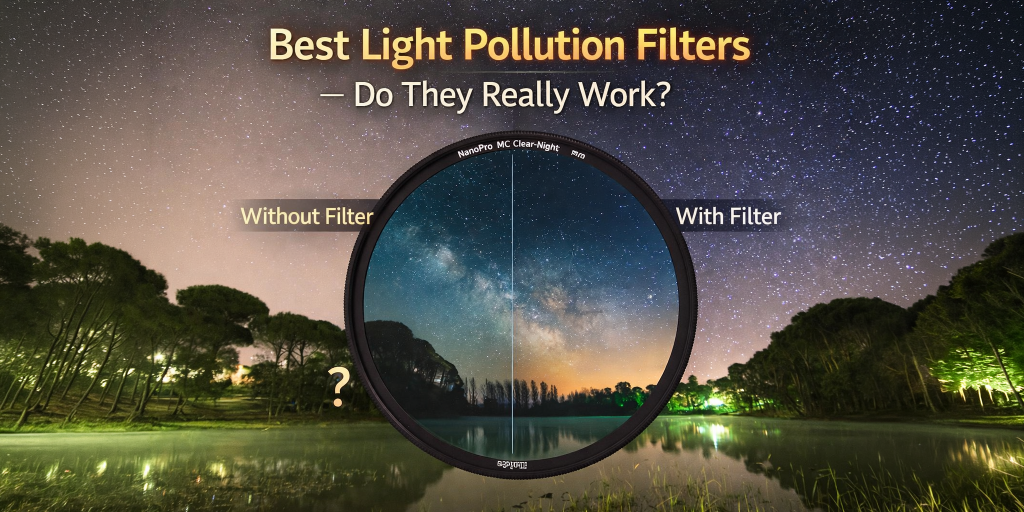
For many amateur astronomers, the biggest obstacle to observing the night sky is not the telescope, the weather, or even experience. It is the sky itself. In modern cities and suburban environments, artificial lighting brightens the atmosphere so much that faint celestial objects become difficult—or sometimes impossible—to see. This phenomenon, known as light pollution, has become one of the most significant challenges for modern astronomy.
Because of this, many observers eventually ask the same question: can light pollution filters actually improve telescope observations?
The answer is both simple and nuanced. Light pollution filters can indeed improve certain astronomical observations by increasing contrast between celestial objects and the bright background sky. However, they are not a universal solution, and understanding how they work is essential before deciding whether they are worth adding to your astronomy setup.
What Light Pollution Actually Does to the Night Sky
Light pollution occurs when artificial light from cities, streets, and buildings is scattered by particles in the atmosphere. Instead of traveling downward to illuminate the ground, part of the light reflects off molecules and aerosols in the air and spreads across the sky. The result is a diffuse glow that reduces the contrast between stars, nebulae, and the surrounding sky.
Research such as the World Atlas of Artificial Night Sky Brightness has shown that a large portion of the global population now lives under skies significantly affected by artificial lighting. Organizations like the International Dark-Sky Association have documented how artificial illumination has steadily increased over the past decades, dramatically changing how the night sky appears in many regions of the world.
Under these conditions, faint objects become harder to detect because the human eye—and even telescopes—must compete with the brightness of the sky itself.
How Light Pollution Filters Work
Light pollution filters do not eliminate light pollution completely. Instead, they work by selectively blocking specific wavelengths of light while allowing others to pass through. Many artificial light sources emit strong light at particular wavelengths. Traditional streetlights, for example, often emit light dominated by sodium or mercury spectral lines.
Astronomical filters are designed to suppress these wavelengths while allowing the wavelengths emitted by certain astronomical objects to pass through. Emission nebulae, for instance, often radiate strongly in specific wavelengths of oxygen and hydrogen. By transmitting those wavelengths while blocking others, filters can improve the visibility of these nebulae against the bright sky.
This principle is based on well-established astronomical spectroscopy and the study of emission lines in interstellar gas, which are widely documented in astrophysical research.
When Light Pollution Filters Work Best
Light pollution filters tend to be most effective when observing emission nebulae, such as the Orion Nebula or the Lagoon Nebula. These objects emit light primarily at specific wavelengths that filters are designed to transmit. When the background sky is partially suppressed, the nebula can stand out more clearly.
However, filters are far less effective for many other types of astronomical targets. Galaxies, star clusters, and reflection nebulae emit light across a broad spectrum rather than at narrow emission lines. Because of this, blocking parts of the spectrum also reduces the light from the object itself.
For these objects, the most effective solution is still observing from darker locations rather than relying solely on filters.
Types of Light Pollution Filters
Several categories of filters are commonly used in amateur astronomy. Each type targets different wavelengths and observing goals.
Broadband light pollution filters attempt to reduce common artificial lighting wavelengths while preserving most of the visible spectrum. These filters can provide modest improvements under suburban skies but are less effective under heavy urban light pollution.
Narrowband filters are more specialized and transmit only specific wavelengths associated with nebular emission. These filters can significantly improve contrast for emission nebulae, especially when used with larger telescopes.Even more selective are oxygen-III filters, often called OIII filters, which isolate the spectral lines produced by doubly ionized oxygen. These filters are particularly useful for planetary nebulae and certain supernova remnants.
The Limits of Light Pollution Filters
Although filters can improve certain observations, they cannot completely restore a dark sky. Modern lighting technologies, especially LED streetlights, produce broad-spectrum light that is more difficult to filter effectively than older sodium lamps.
Because of this, many astronomers emphasize that the most powerful solution to light pollution is still traveling to darker skies whenever possible. Filters can enhance specific observations, but they cannot fully compensate for severe skyglow.
Do Light Pollution Filters Really Work?
In the right circumstances, yes. Light pollution filters can improve contrast and make certain nebulae easier to see, particularly in moderately light-polluted environments. For observers who frequently view emission nebulae, a good narrowband filter can become one of the most useful accessories in their astronomy toolkit.
However, they should be seen as tools rather than solutions. They enhance particular observations but cannot replace dark skies or large telescope apertures.
In the end, the most powerful combination for astronomy remains simple: dark skies, good optics, and patience under the stars.