There’s a piece of astronomy equipment that looks like it was built in someone’s garage, costs less than a decent smartphone, and can show you galaxies two million light-years away.
It’s called a Dobsonian telescope. And it might be the most quietly revolutionary invention in the history of amateur astronomy.
Wait, What Even Is a Dobsonian?
Picture a big tube sitting on a wooden box. That’s it. That’s the telescope.
No computers. No motors. No complicated tripod legs that take 40 minutes to set up. Just a large mirror inside a tube, mounted on a base that lets you swing it left, right, up, and down. Like a really high-tech paper towel roll on a lazy Susan — except you can see the rings of Saturn with it.
The design is named after John Dobson, a San Francisco amateur astronomer and lifelong obsessive who spent decades dragging telescopes onto street corners and into parking lots so strangers could look through them. His goal wasn’t to build the fanciest telescope. It was to build the biggest telescope that anyone could actually afford.
He succeeded so completely that his design is still the dominant recommendation for beginners — 60 years later.
Why Size Actually Matters (In Telescopes)
Here’s the thing about telescopes that most beginner buyers don’t know: magnification is basically a marketing lie.
Any telescope can technically magnify. You change an eyepiece, you change the magnification. It’s not a fixed property, and cranking it up without a good optical foundation just gives you a bigger, blurrier mess.
What actually determines what you can see is aperture — the diameter of the main mirror or lens. Aperture controls light-gathering power, and light is everything in astronomy. Faint galaxies, distant nebulae, the fine structure of Saturn’s rings — all of it comes down to how many photons your telescope can collect.
The physics is brutal and beautiful: double the aperture, and you collect four times the light. That’s not marketing, that’s the square-aperture law, the same principle that drives the design of every professional observatory on the planet.
So when you see a $79 telescope at the toy store boasting “450x magnification,” what you’re actually looking at is a small-aperture instrument dressed up in fake ambition. It will disappoint you. Guaranteed.
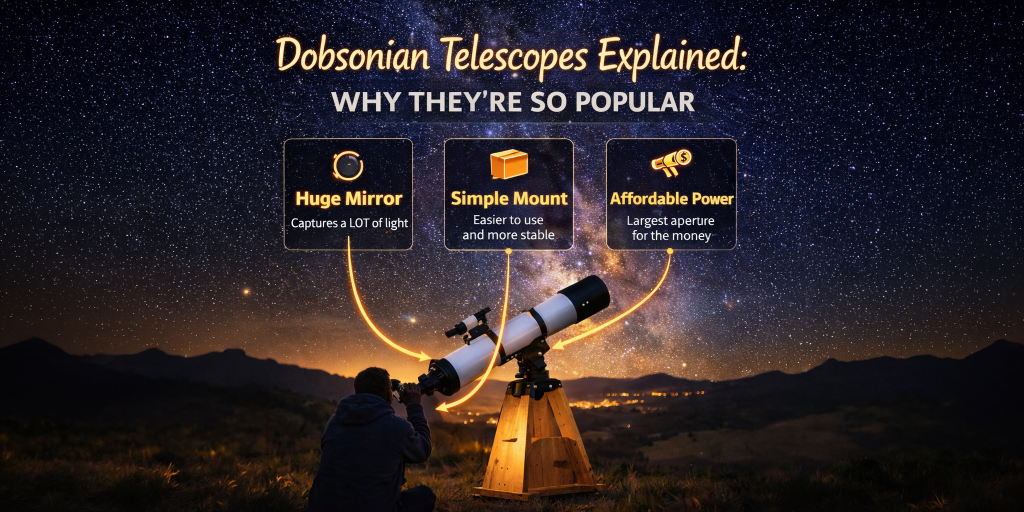
A Dobsonian solves this by making one ruthless trade: you get a massive mirror, and in exchange, the mount is dead simple. No frills. Just aperture.
The Rebel Who Built It in His Garage
John Dobson didn’t come from a traditional astronomy background. He was a monk — a Vedanta monk in San Francisco — who became obsessed with the universe and started building telescopes out of porthole glass, plumbing pipes, and cardboard.
He co-founded the San Francisco Sidewalk Astronomers in 1968, a group dedicated entirely to dragging large telescopes into public spaces so regular people could look through them. Not into observatories. Into parking lots. Bus stops. Street corners.
Dobson’s philosophy was democratic to the core: the universe belongs to everyone, and the barriers to seeing it should be as low as possible. His simplified, affordable telescope design — the Dobsonian mount — made that possible at a scale that expensive, complex instruments never could.
The design spread through the amateur astronomy world in the 1970s and 80s, and it never really stopped. Today, when astronomy educators and experienced observers want to recommend one telescope that will change someone’s relationship with the night sky, they almost always point to a Dobsonian.
What You Actually See Through One
Let’s be real about one thing first: the view through a telescope eyepiece does not look like a NASA photograph. Those images are hours of long-exposure data, stacked and processed with sophisticated software. The universe through an eyepiece is quieter than that.
But here’s the thing — it’s real. And that changes everything.
The Moon at moderate magnification is almost too much to process. It stops being a flat disc and becomes a geological world. Craters cast shadows. Mountain ranges catch the light. The terminator — the line between day and night — makes the surface look almost three-dimensional. This is not a photograph. You are watching it in real time.
Saturn is, without exception, the moment. Every amateur astronomer remembers the first time. You nudge the telescope, find the dot, increase the magnification — and there it is. A planet with rings. Not a rendering, not a stock image. Real, physical rings, hanging there in the dark. First-timers often go quiet for a while.
Jupiter shows its cloud bands and the four Galilean moons that Galileo observed in 1610 with a far inferior instrument. Those moons change position night to night. You can watch the solar system move in real time.Nebulae and galaxies — this is where a big Dobsonian mirror earns its keep. The Orion Nebula glows. The Andromeda Galaxy stretches across the eyepiece — and that light left its source over two million years ago, long before modern humans existed. A good 8-inch Dobsonian makes this accessible from a suburban backyard.
The One Thing It Can’t Do
Dobsonian telescopes are built for looking, not for photographing.
Long-exposure astrophotography — the kind that produces those stunning deep-sky images — requires a mount that can track the rotation of the Earth with mechanical precision over minutes or hours. Dobsonian mounts don’t do that. You guide the telescope manually, nudging it every 30–60 seconds at high magnification to keep objects in view.
For imaging faint galaxies and nebulae, you need an equatorial motorized mount. That’s a different — and significantly more expensive — kind of setup.
But for pure visual astronomy? For the act of just looking at the universe with your own eyes? Nothing in this price range touches it.
Why This Simple Wooden Box Outlasted Everything
The telescope industry has thrown everything at the amateur astronomy market over the past few decades. Computerized “GoTo” mounts that find objects automatically. App-controlled telescopes. Smartphone-integrated optics.
Some of those innovations are genuinely useful. And yet — the Dobsonian is still here, still the first recommendation from most experienced astronomers, still unchanged in its fundamental design from what John Dobson was building out of porthole glass sixty years ago.
Why? Because the core insight holds: aperture beats complexity, every time, for visual astronomy.
A computerized mount that finds objects for you is convenient. But it doesn’t make those objects look any brighter. It doesn’t reveal the structure of a galaxy that a smaller mirror can’t resolve. It doesn’t change the physics.
The Dobsonian doesn’t try to automate the experience. It maximizes the experience — more light, more detail, more universe — and leaves the rest to the person looking through the eyepiece.
That philosophy turned out to be pretty durable.
So Should You Buy One?
If you want to explore the night sky visually, have a budget of roughly €350–700, and care more about what you can see than what your telescope looks like on a shelf — yes. Absolutely.
The sweet spot for most beginners is a 6- or 8-inch Dobsonian from a reputable brand like Sky-Watcher or Orion. You’ll spend €450–650, you’ll be set up in under ten minutes, and on your first clear night you’ll understand exactly why this design has outlasted every trend in amateur astronomy for six decades.
Find a dark spot. Point it at Saturn. Look.
John Dobson would have approved.