
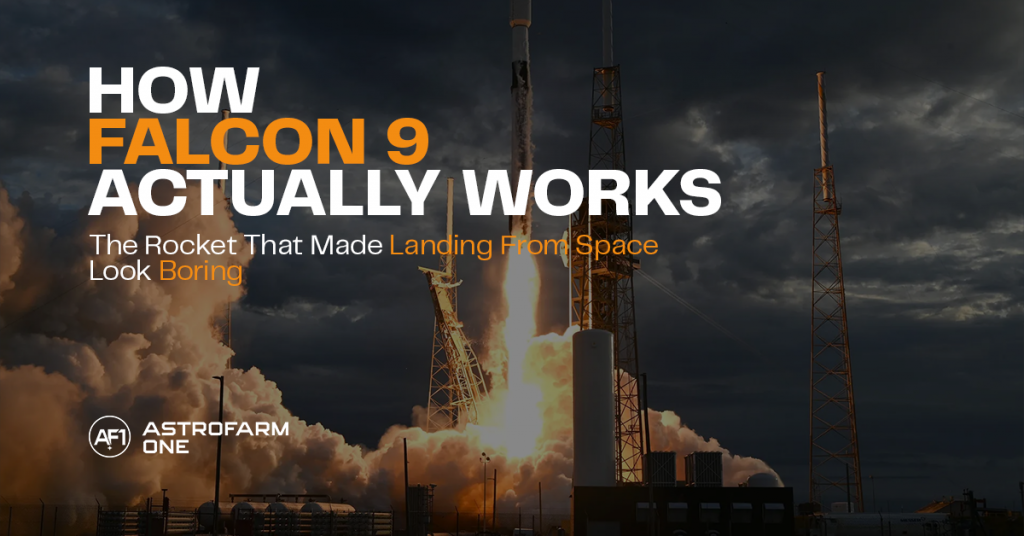
SpaceX Turned Science Fiction Into Routine. Here’s the Engineering That Made It Possible.
In 2015, SpaceX landed a rocket booster for the first time. People lost their minds.
Now they do it so often that it barely makes the news. As of 2024, SpaceX has successfully landed Falcon 9 boosters over 300 times. Some individual boosters have flown more than 20 missions.
This is not normal. For 60 years, rockets were disposable. You launched them, they did their job, and they fell into the ocean or burned up in the atmosphere. Building a new rocket for every mission was just how spaceflight worked.
Falcon 9 changed that. And understanding how it works explains why space suddenly got a lot cheaper.
Two Stages, One Philosophy
Falcon 9 is a two-stage rocket. That means it has two separate sections, each with its own engines and fuel, stacked on top of each other.
The first stage does the heavy lifting — literally. It fires at launch, fights through the thickest part of the atmosphere, and accelerates the rocket to several times the speed of sound. This is the part that comes back and lands.
The second stage takes over after separation. It ignites in the thin upper atmosphere or in space, and delivers the payload (satellites, cargo, or crew) to its final orbit. This stage is not recovered — it either burns up on reentry or is deorbited into the ocean.
The first stage is the expensive part. It contains nine Merlin engines, sophisticated avionics, guidance systems, and landing hardware. Recovering it saves tens of millions of dollars per launch.
The Merlin Engine: Workhorse of the Fleet
The first stage is powered by nine Merlin 1D engines arranged in a circular pattern called an octaweb. Together, they produce about 7.6 meganewtons of thrust at sea level — enough to lift the fully fueled rocket, which weighs about 549 metric tons.
Each Merlin engine burns RP-1 (a refined kerosene) and liquid oxygen (LOX). This propellant combination is dense, relatively cheap, and well-understood. It’s not the most efficient option — hydrogen-oxygen engines produce more thrust per kilogram of fuel — but it’s practical, reliable, and easier to handle.
The engines can throttle down to about 40% of their maximum thrust. This is crucial for landing — a single Merlin engine at minimum throttle still produces more thrust than the nearly-empty booster weighs, so landings have to be precisely timed. There’s no hovering.
The center engine is mounted on a gimbal, allowing it to swivel and steer the rocket during powered flight. During landing, only one or three engines fire, and the center engine does most of the steering.
How the Landing Actually Works
Here’s what happens after the first stage separates from the second stage, about 2-3 minutes into flight:
The booster flips around. Cold gas thrusters (small jets of nitrogen) rotate the stage so it’s pointing engines-first toward the direction of travel. It’s now flying backwards through space at several thousand kilometers per hour.
The boostback burn. For missions returning to the launch site, some engines reignite to slow the booster and reverse its trajectory. For drone ship landings (further downrange), this burn is shorter or skipped.
Reentry. The booster falls back into the atmosphere at hypersonic speeds. Grid fins — four waffle-shaped titanium panels near the top of the booster — deploy and steer the vehicle through the thickening air. They work by deflecting airflow, like rudders on a ship.
The entry burn. A few engines reignite briefly to slow the booster and reduce aerodynamic heating. This burn creates a bubble of relatively cool exhaust gas in front of the engines, partially shielding them from the intense heat of reentry.
The landing burn. In the final seconds, one or three engines fire one last time. Landing legs deploy. The booster touches down at near-zero velocity — either on land (at SpaceX’s landing zones) or on an autonomous drone ship floating in the ocean.
The whole descent takes about 6-8 minutes. The margins are razor-thin. There’s no second chance.
The Drone Ships
For high-energy missions — launching heavy satellites to distant orbits — the booster doesn’t have enough fuel to fly all the way back to land. Instead, it lands on an autonomous drone ship positioned hundreds of kilometers downrange in the ocean.
These ships are essentially floating landing pads. They’re named after ships from Iain M. Banks’ science fiction novels: Of Course I Still Love You, Just Read the Instructions, and A Shortfall of Gravitas.
The ships hold position using GPS and thrusters. The booster targets them autonomously — there’s no remote pilot. The ship and the rocket coordinate in real-time, adjusting for waves and wind.
Landing a 40-meter-tall rocket on a pitching platform in the middle of the ocean, autonomously, was considered impossible by most experts when SpaceX started attempting it. Now it’s routine.
The Fairing: Catching a Falling House
The payload fairing is the nose cone at the top of the rocket — a two-piece shell that protects satellites during launch. Once the rocket is above most of the atmosphere, the fairing splits and falls away.
Each fairing half is worth about 6 million dollars. They used to just splash into the ocean and sink. Now SpaceX recovers them.
The fairing halves deploy small parachutes to slow their descent, then guided parafoils to steer toward recovery vessels. SpaceX tried catching them in giant nets on boats (seriously), but eventually settled for fishing them out of the water and refurbishing them.
Recovered fairings are now regularly reused, adding more savings to an already economical system.
The Numbers That Changed the Industry
Before Falcon 9, launching a kilogram to low Earth orbit cost roughly $10,000-20,000 depending on the rocket. Falcon 9 brought that down to around $2,700 per kilogram — and it’s still falling.
A new Falcon 9 booster costs SpaceX an estimated $28 million to build. If you use it once and throw it away, that cost is passed to the customer. If you use it 15 times, the per-flight cost of the hardware drops dramatically.
As of early 2024, SpaceX has flown individual boosters more than 20 times. The fleet leader has logged over 20 successful flights and landings on the same first stage. That’s not refurbishment between flights — it’s rapid reuse, sometimes with turnaround times of just weeks.
This is why SpaceX can offer launches at prices competitors can’t match, while still making a profit. And it’s why they can afford to launch their own Starlink satellite constellation — they’re essentially launching at cost.
What Makes This Actually Hard
Landing a rocket sounds simple in principle: point the engines down, fire at the right moment, touch down gently. In practice, it required solving dozens of engineering problems that had never been solved before.
The rocket must reserve enough fuel for landing burns — but fuel is weight, and every kilogram of fuel kept for landing is a kilogram that can’t be used for payload. The optimization is brutally tight.
The guidance system must track position and velocity with extreme precision while the vehicle is being buffeted by hypersonic winds, heating unevenly, and steering with aerodynamic surfaces that behave differently at every altitude.
The engines must reignite reliably after being shut down in the cold vacuum of space, then shut down again, then reignite again — all while fuel is sloshing around in nearly-empty tanks.
The landing legs must deploy at the last second, absorb the impact, and keep a 25-ton vehicle upright on a surface that might be moving.
SpaceX failed many times before succeeding. They crashed boosters into the ocean, into drone ships, and onto landing pads. Each failure was analyzed, and the system improved. Now the landing success rate exceeds 95%.
Why This Matters Beyond SpaceX
Falcon 9 proved that reusable rockets are possible. That changed the economics of space.
Before SpaceX, launching satellites was so expensive that only governments and the largest corporations could afford it. Now startups launch small satellites. Universities launch research payloads. The cost barrier has dropped low enough that space is accessible to a much wider range of players.
And Falcon 9 is just the beginning. SpaceX is developing Starship — a fully reusable system where both stages land and fly again. Other companies are racing to build their own reusable rockets.
What was science fiction in 2010 is routine in 2024. And what’s routine today will seem primitive compared to what’s coming.
That’s the real achievement of Falcon 9: not just landing rockets, but proving that the old way of doing things wasn’t the only way. Sometimes the impossible just takes a few more attempts.
Sources
SpaceX – Falcon 9 Overview – https://www.spacex.com/vehicles/falcon-9/
NASA – Commercial Crew Program – https://www.nasa.gov/commercial-crew-program
FAA – Commercial Space Launch Data
Spaceflight Now – Launch Tracking
SpaceX Stats Community Database – https://www.spacexstats.xyz