The Supermoon Is Back. Again. For the Fifth Time This Decade. And It’s Still ‘Rare.’
You’ve seen the headlines.
‘RARE Supermoon to Light Up the Sky Tonight!’ ‘Once-in-a-Generation Meteor Shower!’ ‘You Won’t See This Again for 100 Years!’
And then, six months later: the same headline. Different event. Same breathless urgency.
Here’s the uncomfortable truth: most astronomical events branded as ‘once-in-a-lifetime’ are anything but. The media has discovered that space sells — and that your FOMO is worth more than your trust.
Let’s break down the hype machine, separate the genuinely rare from the routinely overhyped, and figure out which events actually deserve your attention.
The Supermoon Scam
Let’s start with the most overused term in modern astronomy coverage: the supermoon.
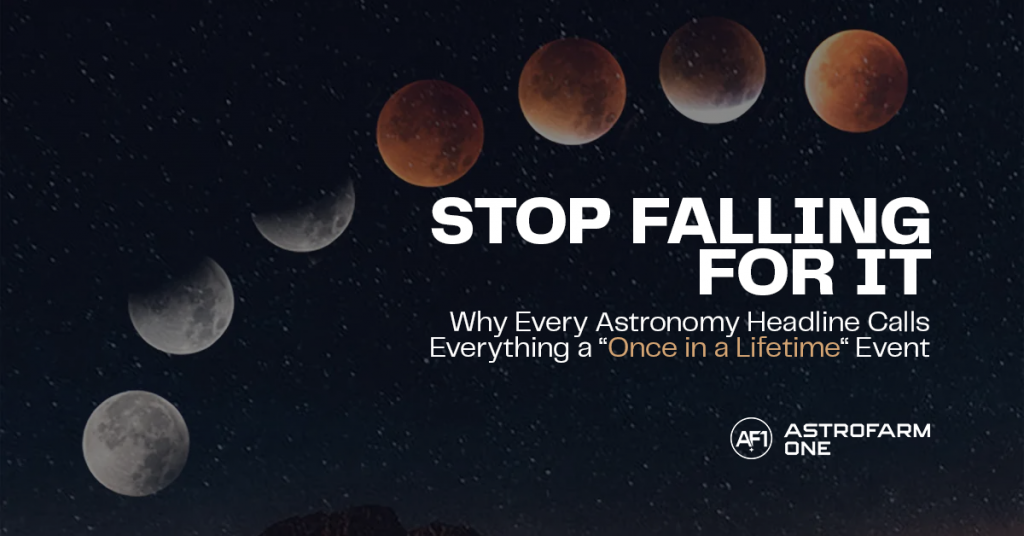
A supermoon occurs when a full moon coincides with the Moon’s closest approach to Earth (perigee). The Moon’s orbit is elliptical, so its distance from Earth varies. At perigee, it’s about 363,000 km away. At apogee (farthest point), it’s about 405,000 km away.
The result? A supermoon appears about 7% larger and 15% brighter than an average full moon.
Can you perceive a 7% size difference with your naked eye? Studies suggest most people cannot — not without a side-by-side comparison that’s physically impossible in real-time observation.
But here’s the real kicker: supermoons happen 3-4 times per year. Every year. Without fail.
That’s not rare. That’s seasonal. It’s less rare than your birthday.
Yet every single time, the headlines scream about this ‘extraordinary’ celestial event. The term ‘supermoon’ didn’t even exist in astronomical literature until 1979, when astrologer Richard Nolle coined it. Astronomers prefer ‘perigee-syzygy’ — a term so unsexy it never made it into a headline.
The ‘Rare’ Meteor Shower That Happens Every Single Year
Every August, headlines announce the Perseid meteor shower like it’s a surprise visitor. ‘Don’t Miss This Rare Celestial Show!’
The Perseids have occurred every August for at least 2,000 years. They’re documented in Chinese astronomical records from 36 AD. They will continue occurring every August for thousands of years to come, as long as Comet Swift-Tuttle keeps orbiting the Sun.
That’s not rare. That’s more reliable than tax season.
The same applies to the Geminids (December), Quadrantids (January), Lyrids (April), and a dozen other annual meteor showers. They’re as predictable as holidays — because they essentially are astronomical holidays.
What varies is viewing conditions: moonlight, weather, and where Earth intersects the debris stream. Some years are better than others. But the shower itself? It’s been showing up on schedule since before your great-great-grandparents were born.
Planetary Conjunctions: Closer Than They Appear (And More Common)
‘Jupiter and Saturn Won’t Be This Close Again for 800 Years!’
You might remember this headline from December 2020, during the ‘Great Conjunction.’ And technically, it was true — Jupiter and Saturn won’t appear quite that close (0.1 degrees) again until 2080.
But here’s what the headlines buried: Jupiter and Saturn have a conjunction roughly every 20 years. The 2020 event was exceptionally close, but conjunctions themselves are routine.
Venus-Jupiter conjunctions? Every 13 months on average. Mars and other planets? Constantly shuffling around the sky, creating ‘rare’ pairings multiple times per year.
The media trick is specificity. ‘This exact configuration won’t repeat for X years’ is technically true for almost any astronomical arrangement — because orbital mechanics are complex and precise repetitions are rare by definition. But close-enough conjunctions? Those happen all the time.
What’s Actually Rare (And Often Under-Hyped)
Here’s the irony: genuinely rare astronomical events often get less breathless coverage than supermoons.
Total solar eclipses visible from your specific location: These actually are rare. Any given point on Earth sees a total solar eclipse roughly once every 375 years on average. The path of totality is narrow (typically 100-150 km wide), and you have to be in exactly the right place. This is legitimately a once-in-a-lifetime event for most locations.
Transits of Venus: Venus passes directly between Earth and the Sun in pairs separated by 8 years, with gaps of over a century between pairs. The last transits were in 2004 and 2012. The next won’t occur until 2117. If you missed it, you missed it for life.
Naked-eye visible supernovae: The last supernova visible without a telescope from Earth was in 1604 (Kepler’s Supernova). We’re statistically overdue for another, but it could happen tomorrow or not for another century. When it does, it will be genuinely unprecedented for anyone alive.
Great comets: Truly spectacular comets — the kind that dominate the sky and are visible in daylight — are genuinely unpredictable. Comet Hale-Bopp in 1997 was magnificent. We might not see another like it for decades, or one might appear next year. That uncertainty is real rarity.
Meteor storms: Regular meteor showers produce 10-100 meteors per hour. True meteor storms — like the 1966 Leonids that produced thousands of meteors per minute — are genuinely rare and often unpredictable.
Why the Media Does This
Let’s be honest: it’s not malicious. It’s economic.
‘Moon Will Be Full Tonight’ doesn’t get clicks. ‘RARE SUPERMOON: Last Chance to See Before 2025!’ does.
Digital media runs on engagement. Headlines are optimized for clicks, not accuracy. And astronomical events have a built-in advantage: they’re visual, they’re accessible, and they come with a deadline. Miss it tonight, miss it forever (supposedly).
The problem is cumulative. When every full moon is ‘super,’ when every meteor shower is ‘rare,’ when every conjunction is ‘once-in-a-lifetime,’ the words lose meaning. Readers either become desensitized or, worse, start ignoring astronomical events entirely because they’ve been burned by hype too many times.
That’s the real cost: not just misled readers, but diminished wonder. When everything is extraordinary, nothing is.
How to Be a Smarter Consumer of Astronomy News
Ask one simple question: How often does this actually happen?
If the answer is ‘annually’ or ‘multiple times per year,’ it’s not rare. It might still be beautiful, worth watching, and enjoyable — but it’s not rare.
If the answer is ‘the last one was before I was born’ or ‘the next one is after I’ll likely die,’ then yes — pay attention.
Check the source. Actual astronomers and established observatories (NASA, ESO, IAU) tend to be more measured in their language. If a headline seems breathless, see if it’s based on a press release or just creative writing by someone who needed content.
And remember: you don’t need ‘rare’ to justify looking up. A regular full moon is still a quarter-million miles of ancient rock reflecting sunlight into your eyes. The Perseids, however predictable, are still comet debris burning up at 60 km/s in Earth’s atmosphere.
The universe is remarkable without the hype. The media just hasn’t figured out how to sell that yet.
Sources
NASA Eclipse Website – https://eclipse.gsfc.nasa.gov
International Astronomical Union – https://www.iau.org
EarthSky – https://earthsky.org
Sky & Telescope – https://skyandtelescope.org
International Meteor Organization – https://www.imo.net