The Cosmic Microwave Background: A 13.8 Billion-Year-Old Baby Photo of Everything That Exists
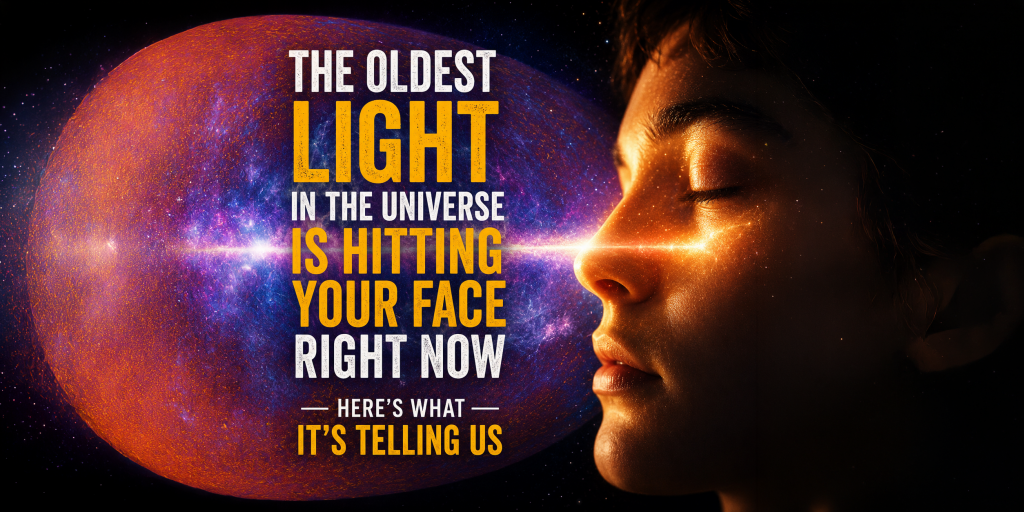
Right now, at this exact moment, ancient light is passing through your body.
Not starlight. Not sunlight. Something far older. Light that has been traveling for 13.8 billion years — since the universe was only 380,000 years old.
It’s everywhere. It fills all of space. You can’t escape it. And it’s one of the most important discoveries in the history of science.
It’s called the Cosmic Microwave Background. And it’s the closest thing we have to a baby photo of the universe.
The Accidental Discovery That Changed Everything
In 1964, two radio astronomers at Bell Labs in New Jersey were trying to detect faint radio signals bounced off balloon satellites. Arno Penzias and Robert Wilson had a problem: no matter where they pointed their antenna, they picked up a persistent background noise.
They checked their equipment. They rebuilt connections. They even climbed inside the antenna and scraped out pigeon droppings, thinking the birds might be the source of the interference.
Nothing worked. The noise was everywhere. It came from every direction in the sky, day and night, regardless of season.
What they had accidentally discovered was the afterglow of the Big Bang itself — the Cosmic Microwave Background radiation, or CMB. They won the Nobel Prize in 1978.
The pigeons, presumably, did not.
What You’re Actually Detecting
To understand the CMB, you need to understand what the early universe looked like.
For the first 380,000 years after the Big Bang, the universe was so hot and dense that atoms couldn’t form. Electrons flew freely, constantly scattering photons (light particles). The universe was opaque — like being inside a fog so thick that light couldn’t travel in a straight line.
Then something changed. The universe expanded and cooled enough (to about 3,000 Kelvin) for electrons and protons to combine into neutral hydrogen atoms. Suddenly, photons could travel freely without being scattered.
This moment is called recombination. The universe became transparent. And all those photons — the light that had been bouncing around in that primordial fog — were released to travel through space.
Those are the photons we detect today as the CMB. They’ve been traveling for 13.8 billion years, stretched by the expansion of the universe from visible light to microwave radiation.
When you tune an old analog TV to a channel with no signal, about 1% of that static is CMB radiation. You’re literally watching the Big Bang.
The Temperature of Everything
The CMB has a temperature. And it’s the same temperature everywhere we look: 2.725 Kelvin. That’s about -270.4 degrees Celsius, or just 2.725 degrees above absolute zero.
This uniformity is astonishing. Look in any direction — toward the constellation Virgo, toward Orion, toward the Southern Cross — and the CMB temperature is the same to within one part in 100,000.
This tells us something profound: the early universe was remarkably uniform. Matter and energy were distributed almost perfectly evenly in all directions.
Almost.
The Tiny Ripples That Became Everything
Here’s the thing: if the early universe had been perfectly uniform, we wouldn’t exist.
Gravity needs something to work with. For matter to clump together into galaxies, stars, and planets, there had to be tiny density variations — regions where matter was slightly more concentrated than average.
Those variations exist. They’re imprinted in the CMB as temperature fluctuations of about 0.00001 degrees — one hundred-thousandth of a degree warmer or cooler than average.
These tiny ripples are the seeds of all cosmic structure. The slightly denser regions had slightly stronger gravity. They attracted more matter over time. Over billions of years, they grew into the galaxy clusters, galaxies, and stars we see today.
When you look at a map of CMB temperature fluctuations, you’re looking at the blueprint of the universe. Those blotches of slightly warmer and cooler regions? That’s where galaxies were going to form. That’s where we were going to form.
What the CMB Tells Us About Cosmology
The CMB isn’t just pretty. It’s a precision instrument for measuring the universe.
By analyzing the patterns in the CMB — the size and distribution of those temperature fluctuations — cosmologists have determined the age of the universe (13.8 billion years), its geometry (flat), its composition (5% ordinary matter, 27% dark matter, 68% dark energy), and the rate at which it’s expanding.
The CMB also provides strong evidence for cosmic inflation — a theory that the universe underwent a brief period of exponential expansion in the first fraction of a second after the Big Bang. Inflation explains why the CMB temperature is so uniform: regions that are now on opposite sides of the observable universe were once close enough to reach thermal equilibrium before being stretched apart.
Without inflation, there’s no good explanation for why parts of the universe that have never been in contact have the same temperature. With inflation, it makes sense.
The Missions That Mapped the Baby Universe
Since Penzias and Wilson’s accidental discovery, we’ve sent three major space missions to map the CMB with increasing precision.
COBE (Cosmic Background Explorer), launched in 1989, made the first precise measurements of the CMB spectrum and detected the temperature fluctuations. Its lead scientists, John Mather and George Smoot, won the Nobel Prize in 2006.
WMAP (Wilkinson Microwave Anisotropy Probe), launched in 2001, mapped the CMB with 35 times better resolution than COBE. It pinned down the age and composition of the universe with unprecedented accuracy.
Planck, launched by the European Space Agency in 2009, achieved even higher resolution and sensitivity. Its final maps, released in 2018, represent our most detailed picture of the infant universe.
Each mission revealed more detail in those ancient fluctuations, refining our understanding of cosmology.
The Horizon Problem and What We Can’t See
The CMB represents a surface — the most distant thing we can ever observe with light. Beyond it, the universe was opaque. We can’t see further back in time using electromagnetic radiation.
This is called the surface of last scattering. It’s not a physical surface, but a moment in time — the moment when the universe became transparent, frozen into the pattern of the CMB.
What lies beyond? The first 380,000 years of the universe remain hidden from direct observation. To probe that era, we’d need something other than light — perhaps gravitational waves from the Big Bang itself, or neutrinos released even earlier than the CMB photons.
Scientists are searching for these signals. If found, they would open a window into the universe’s earliest moments — before atoms, before the CMB, back to the first fractions of a second.
Why This Matters
The CMB is proof that the Big Bang happened. It’s one of the strongest pieces of evidence for our current model of cosmology.
Before its discovery, the Big Bang was one of several competing theories about the origin of the universe. After its discovery — and especially after the precision measurements of COBE, WMAP, and Planck — the Big Bang model became the standard framework for cosmology.
The CMB tells us that the universe had a beginning. It tells us how old the universe is. It tells us what the universe is made of. It tells us the shape of space itself.
And it’s everywhere. Right now. Passing through the walls, through the air, through you.
The oldest light in existence, carrying information from a time before stars, before galaxies, before anything we would recognize as the universe today.
It’s the most ancient photograph ever taken. And we’re all living inside it.
Sources
NASA WMAP – https://map.gsfc.nasa.gov
ESA Planck Mission – https://www.esa.int/Science_Exploration/Space_Science/Planck
Penzias, A. A., Wilson, R. W. (1965) – A Measurement of Excess Antenna Temperature – Astrophysical Journal
Smoot, G. F. et al. (1992) – Structure in the COBE differential microwave radiometer first-year maps – Astrophysical Journal
Nobel Prize – Penzias and Wilson (1978), Mather and Smoot (2006)