You Won’t Die Instantly. You’ll Be Stretched Into Spaghetti While Time Itself Breaks Down Around You.
Let’s get the bad news out of the way: if you fall into a black hole, you’re not coming back.
Not because we lack the technology. Not because rescue is difficult. But because the laws of physics themselves won’t allow it. Once you cross the event horizon, every possible path through spacetime — including the path back out — leads further in.
But here’s the weirder news: what happens to you inside depends on who’s watching.
And that’s where things get truly strange.
The Point of No Return
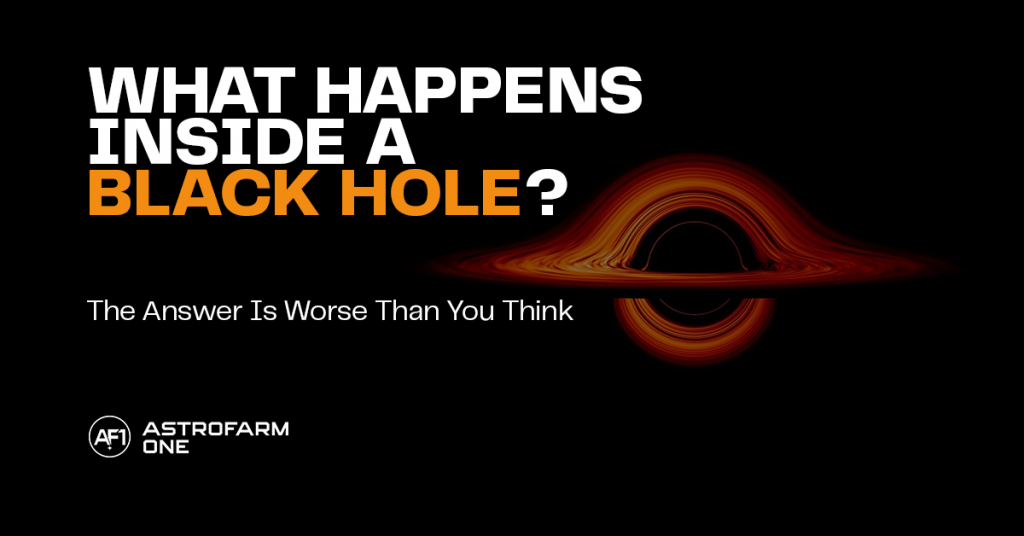
A black hole isn’t a thing. It’s a region of spacetime where gravity has become so extreme that nothing — not matter, not light, not information — can escape.
The boundary of this region is called the event horizon. It’s not a physical surface. You wouldn’t feel yourself crossing it. There’s no wall, no membrane, no sign that says ‘Welcome to Oblivion.’
But the moment you cross it, your fate is sealed. The escape velocity at the event horizon equals the speed of light. Since nothing can travel faster than light, nothing can escape. Not even a photon fired directly outward.
The size of the event horizon depends on the black hole’s mass. For a black hole with the mass of our Sun, the event horizon would be about 6 kilometers in diameter. For the supermassive black hole at the center of our galaxy (4 million solar masses), it’s about 24 million kilometers across — roughly 17 times the diameter of the Sun.
Spaghettification: Yes, That’s the Scientific Term
If you fall into a stellar-mass black hole (a few times the mass of the Sun), you’ll be killed before you even reach the event horizon. The culprit: tidal forces.
Gravity gets stronger the closer you are to the source. If you’re falling feet-first toward a black hole, your feet are closer to the singularity than your head. They experience stronger gravity. The difference in gravitational pull between your head and your feet stretches you.
At the same time, the parts of your body on either side are being pulled toward the center of the black hole, compressing you laterally.
The result: you’re stretched vertically and squeezed horizontally. Like spaghetti. Physicists actually call this spaghettification. It’s not a joke. It’s in the textbooks.
For a stellar-mass black hole, spaghettification would begin hundreds of kilometers before you reach the event horizon. You’d be torn apart in a fraction of a second.
But here’s the twist: supermassive black holes are more survivable — at least initially. Because the event horizon is so much larger, the tidal forces at the horizon are actually weaker. You could cross the event horizon of a supermassive black hole intact, alive, and wondering what all the fuss was about.
The spaghettification would come later. But it would still come.
Time Dilation: The Universe Watches You Freeze
Here’s where your experience diverges from everyone else’s.
From your perspective, falling into a black hole happens in finite time. You cross the event horizon. You continue falling. Eventually, you hit the singularity (or whatever is actually there). End of story.
But from the perspective of someone watching from a safe distance, something completely different happens.
As you approach the event horizon, gravitational time dilation becomes extreme. Time passes more slowly for you relative to the distant observer. The light you emit gets stretched to longer and longer wavelengths (redshifted) and takes longer and longer to reach the observer.
To the outside observer, you appear to slow down. You never actually cross the event horizon. You just get dimmer and redder, frozen at the edge of the black hole for eternity.
In practice, you’d fade from view within a fraction of a second as your image redshifts out of the visible spectrum. But mathematically, your image lingers at the horizon forever.
Both perspectives are correct. This isn’t an illusion. This is what relativity actually predicts.
The Singularity: Where Physics Gives Up
At the center of every black hole — according to general relativity — is a singularity. A point of infinite density, zero volume, and infinite spacetime curvature.
This is where the math breaks. Infinities in physics usually mean the theory has reached its limits. General relativity is screaming at us: ‘I don’t work here. Something else is happening that I can’t describe.’
We suspect that quantum mechanics becomes important at the singularity. Gravity, spacetime, matter — they might all behave in ways we can’t currently predict. The singularity might not even be a point. It might be something else entirely.
But we don’t have a complete theory of quantum gravity. Until we do, the singularity remains a mystery wrapped in an event horizon.
What we do know: once you’re inside the event horizon, the singularity isn’t just ahead of you in space. It’s ahead of you in time. Every possible future, every trajectory through spacetime, ends at the singularity. It’s not a place you fall toward. It’s an inevitability you can’t avoid.
The Information Paradox: You Break Physics Just by Falling In
Here’s a problem that has kept physicists arguing for 50 years.
Quantum mechanics says information can never be destroyed. Every physical process is theoretically reversible — if you knew the exact quantum state of a system, you could reconstruct its past.
But black holes seem to destroy information. Throw a book into a black hole. The black hole grows slightly larger, but the information about the book — its contents, its structure, its history — appears to be lost forever behind the event horizon.
Eventually, black holes evaporate through Hawking radiation — a slow process where quantum effects near the event horizon cause the black hole to emit particles and lose mass over astronomical timescales. When the black hole finally evaporates completely, what happened to the information inside?
If it’s destroyed, quantum mechanics is wrong. If it escapes somehow, we don’t understand how. This is the black hole information paradox, and it remains unsolved.
Some physicists believe the information is encoded in the Hawking radiation. Others propose it’s stored on the event horizon itself, like a hologram. Others suggest the information falls into a new baby universe. We don’t know.
What We Actually Know vs. What We’re Guessing
We’ve never observed the inside of a black hole. We never will — by definition, no information can escape to tell us what’s there.
What we know is based on general relativity, which has been tested extensively and works brilliantly in every situation we can actually observe. The existence of event horizons, the behavior near them, the gravitational waves from merging black holes — all of this matches predictions.
But general relativity also predicts singularities, which are almost certainly not physically real. Something else happens at extreme densities — something that requires a theory we haven’t fully developed yet.
The interior of a black hole is where our two best theories — general relativity and quantum mechanics — collide and contradict each other. Solving that contradiction is one of the great open problems in physics.
The Bottom Line
If you fall into a black hole, here’s what happens:
You cross the event horizon. Depending on the black hole’s size, you might be spaghettified before this or survive the crossing intact. Either way, once you’re in, you’re in.
Time continues for you, but the singularity is now in your future. Every path leads there. You have minutes, maybe hours if it’s a supermassive black hole, before tidal forces tear you apart.
To outside observers, you never crossed. You froze at the horizon, fading to invisibility.
At the singularity — or whatever replaces it in a complete theory — you meet an end we can’t fully describe.
And the information that was you? It becomes part of a paradox we’re still trying to solve.
Black holes are where our understanding of the universe reaches its edge. And the view from that edge is terrifying, beautiful, and utterly alien.
Sources
NASA Science – Black Holes – https://science.nasa.gov/astrophysics/focus-areas/black-holes
Hawking, S. W. (1974) – Black hole explosions? – Nature, 248, 30-31
Penrose, R. (1965) – Gravitational Collapse and Space-Time Singularities – Physical Review Letters
Event Horizon Telescope – https://eventhorizontelescope.org
LIGO Scientific Collaboration – https://www.ligo.org