Your Smartphone Is Now A Better Star Chart Than Anything Astronomers Had 30 Years Ago. Here’s How To Choose The Right One.
Twenty years ago, learning the night sky required a printed star atlas, a planisphere, a red flashlight, and months of patience.
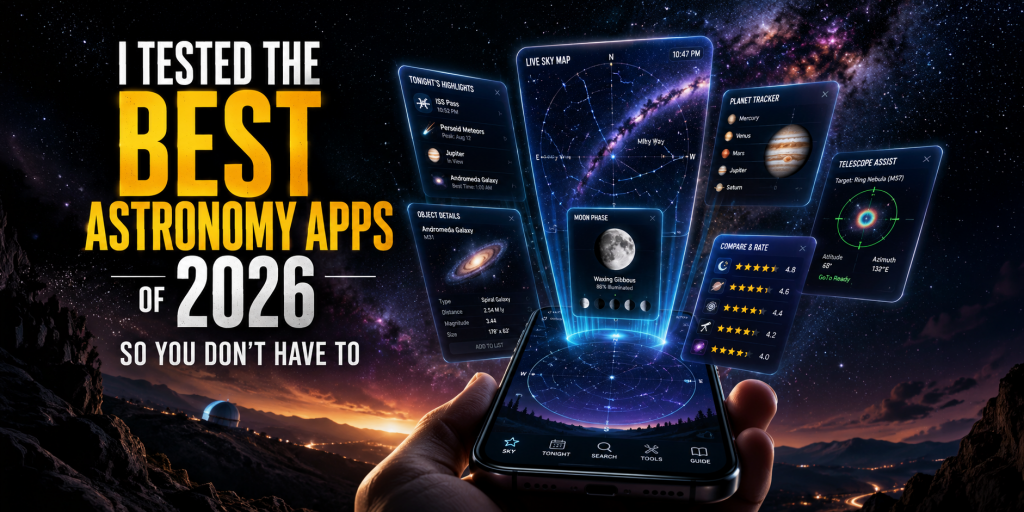
Today, you hold your phone up to the sky and it labels every star, planet, constellation, and satellite passing overhead. In real time. For free.
The astronomy app ecosystem has exploded. There are dozens of options, half of them excellent, the other half cluttered with ads and locked features. So which ones actually deserve space on your phone?
Here’s the honest breakdown of what’s worth installing in 2026 — sorted by what they actually do, not by what their marketing claims.
Best Overall: SkySafari
If you’re serious about astronomy, this is the app to beat.
SkySafari has been the gold standard for serious amateur astronomers for years. Its database includes 100 million stars, 3 million galaxies down to 18th magnitude, and 750,000 solar system objects. That’s not a hobbyist’s tool — that’s a professional-grade catalog in your pocket.
The 2026 version (SkySafari 8 Plus) added more powerful event-finding tools, deeper sky chart customization, built-in astrophotography galleries, and plate solving that links your images directly to the night sky.
The killer feature: telescope control via Wi-Fi. Pair it with a compatible mount and the app becomes a full observing system. You can also build custom observing lists, log observations with notes, and use the ‘Tonight’s Best’ feature to see what’s optimally placed each night.
Cost: SkySafari 8 Plus runs around $17-22 depending on platform. Pro versions exist for advanced users. There’s a free basic version, but the Plus or Pro upgrade is where this app earns its reputation.
Best for: Anyone with a telescope, serious observers, anyone planning detailed sessions.
Best Free Option: Stellarium Mobile
Stellarium has been the gold standard in planetarium software for over a decade. The desktop version is free and open-source. The mobile version brings that same quality to your phone.
The free version is genuinely useful: a basic free version offers the usual augmented reality experience, with overlaid stars, constellations, planets, comets, satellites and deep-sky objects. For casual stargazing, you may never need to pay anything.
If you want more power, the step-up Stellarium PLUS version costs around £11.99 and increases the database from 10th magnitude to 22nd magnitude stars. That’s the difference between seeing the bright stars and seeing essentially every star anyone has ever cataloged.
Best for: Beginners on a budget, anyone who wants serious accuracy without committing financially, hardcore observers who want the deep catalog.
Best For Beginners: Star Walk 2
If you’ve ever wanted to point your phone at the sky and have it just work, Star Walk 2 is your app.
Star Walk 2 is the most visually polished planetarium app. Its augmented reality mode, where you point your phone at the sky and see labels overlaid on the real view through your camera, is the smoothest implementation available.
The interface is beautiful. The time-travel feature lets you fast-forward to see what the sky will look like at any moment in the future. It’s the app you show people who say they’re ‘not into space stuff’ — and watch them get hooked.
The trade-off: the object database is smaller than Stellarium or SkySafari, but for naked-eye and binocular targets it covers everything you need. It’s not for hunting down 14th-magnitude galaxies. It’s for actually enjoying the sky.
Best for: Beginners, outreach events, showing kids the constellations, casual stargazing.
Best Design: Sky Guide
Sky Guide is the app you’d design if Apple made an astronomy tool.
The night sky has more realism than ever, including beautifully rendered pre-dawn light, twilight and dusk. The visuals are stunning. The interface is minimalist and intuitive.
The standout feature: the app’s ‘featured’ section contains a mix of excellent news and features by science communicator Dr Jenifer Millard. It’s astronomy content curated by an actual astronomer, not algorithm-generated clickbait.
Cost: Free with optional paid upgrades. The free version is functional, but you’ll likely want the upgrades for more objects and features.
Best for: iPhone users who value design, anyone who wants to learn through curated content, aesthetic-focused stargazers.
Best For Astrophotography: PhotoPills
If you’re trying to photograph the Milky Way, plan a shot of the Moon over a specific landmark, or capture a meteor shower, PhotoPills is non-negotiable.
PhotoPills is the ideal companion for astrophotographers. It helps you to work out the exact time and location to shoot from to get the perfect shot of your target celestial object.
The augmented reality planning tools are unmatched. Want to know exactly where the Milky Way will rise behind that mountain on a specific date? PhotoPills shows you on-site, overlaid on your camera view. It’s the difference between hoping for a good shot and engineering one.
Cost: One-time purchase, no subscription. Worth every cent if you shoot astrophotography seriously.
Best for: Astrophotographers, landscape photographers, anyone planning night shots.
Best For Satellites: Heavens-Above & ISS Detector
Watching the International Space Station glide silently overhead is one of the most accessible wonders in astronomy. These apps make it effortless.
ISS Detector (Android) and similar satellite tracking apps give you precise pass predictions including start time, maximum altitude, brightness, and the exact path across the sky. Push notifications fire before visible passes, so you don’t miss them.
For the deep nerds, Heavens-Above is the definitive resource. It provides predictions for the ISS, Tiangong, Hubble, Starlink trains, and thousands of other satellites. The web version includes interactive sky charts showing exact satellite paths through constellations.
Best for: Anyone who wants to spot the ISS, identify mystery lights moving across the sky, track Starlink trains.
Best For Weather: Astrospheric & Clear Outside
Standard weather apps tell you if it’ll rain. Astronomy weather apps tell you what really matters: cloud cover at multiple altitudes, atmospheric transparency, seeing conditions, and humidity.
A night can be technically ‘clear’ by your regular weather app but have terrible seeing (atmospheric turbulence) that turns Jupiter into a shimmering blob. These tools catch those distinctions.
Astrospheric is the most advanced forecasting service for North American astronomers. Using astronomy data produced by the Canadian Meteorological Center, NOAA, and more, Astrospheric quickly produces a highly accurate 48-hour forecast.
For European users, Clear Outside is the go-to. It provides hour-by-hour forecasts of cloud cover, transparency, seeing, humidity, and wind specifically for astronomers. The color-coded timeline makes it instantly obvious which nights are worth setting up for.
Best for: Anyone who’s hauled gear outside only to be clouded out. Which is everyone.
Best Free For Maximum Objects: Sky Tonight
If you don’t want to pay anything but still want a serious database, Sky Tonight is the dark horse.
Sky Tonight has the biggest free database of space objects on the comparison list — you can find any object without paying extra. It also includes a built-in weather forecast, customizable notifications for events, and stargazing condition predictions based on moon phase and light pollution.
Best for: Anyone who wants serious functionality without paying upfront.
The Free Bonus: The NASA App
Not strictly a stargazing tool, but worth installing anyway.
The NASA app is completely free and has lots to interest space enthusiasts. You’ll find a gallery of recent NASA images, a NASA TV feed, information on all the latest missions and a handy ISS tracker.
It’s not what you’ll use at the telescope. It’s what you’ll scroll through during the day when you want to feel the wonder.
The One Tip Everyone Forgets
Use night mode. Always. Every time.
A blast of white screen light in the middle of an observing session kills your dark adaptation for 20 minutes. Most astronomy apps have a built-in red mode — use it. On iOS, set up an Accessibility shortcut to toggle a red screen filter with a triple-click of the side button.
You can have the best astronomy app in the world, but if you blind yourself every time you check it, you’ve defeated the purpose.
The Honest Recommendation
If you only install three apps, make them:
Stellarium Mobile (free) — for everyday sky identification and planning
Astrospheric or Clear Outside — for knowing whether tonight is even worth bothering with
ISS Detector — for not missing the space station overhead
If you have a telescope or do astrophotography, add SkySafari Plus and PhotoPills. That’s it. That’s the toolkit.
One last thing: no app replaces actually learning the sky. The constellations don’t change. The brightest stars are always in the same place. Over time, you’ll find the sky feels more like home when you can navigate it by memory rather than screen.
But until then? Your phone is a remarkable tool. Use it.
Sources
Space.com – Best Stargazing Apps 2026 – https://www.space.com/best-stargazing-apps
AstroBackyard – 20 Best Astronomy Apps – https://astrobackyard.com/astronomy-apps-for-stargazing/
The Astro Manual – Best Astronomy Apps for Stargazing 2026 – https://theastromanual.com
Sky at Night Magazine – Best Astronomy Apps – https://www.skyatnightmagazine.com
Visit Astronomy – Best Astronomy Apps 2026 – https://www.visitastronomy.com